Points System Full Guide: Trading Points, Referral Points & Decay
Trading Points = Fees × 100. Referral bonus: 10%. How to earn, why points decay, and how to grow your balance sustainably.

Introduction
The points program is the platform's way of recognizing the users who actually use it — and translating that activity into a measurable share of future rewards. The rules are simple enough to fit on a sticky note: you earn points by trading, you earn extra points by referring others, and earning rates step down once your daily output exceeds a defined threshold.
This guide walks through each piece in detail. Once you understand how the formulas work and why the tiered conversion efficiency mechanism exists, you can stop "playing" the points program and start using it the way it's designed: as a clean, fair record of your real engagement with the platform.
1. The Two Ways to Earn Points
There are exactly two ways to accumulate points, and you can use either, both, or neither.
- Trading Points — earned by paying trading fees on the platform.
- Referral Points — earned when users you've referred trade on the platform.
That's it. There are no quizzes, no daily check-ins, no minigames. The system rewards real economic activity — yours and the activity of users you've brought to the platform — and nothing else.
This is intentional. Points-for-clicks programs invite gaming and dilute the signal; points-for-trading-fees-paid is anchored in the most credible measure of engagement available.
2. Trading Points: Fees × 100
The trading points formula is straightforward:
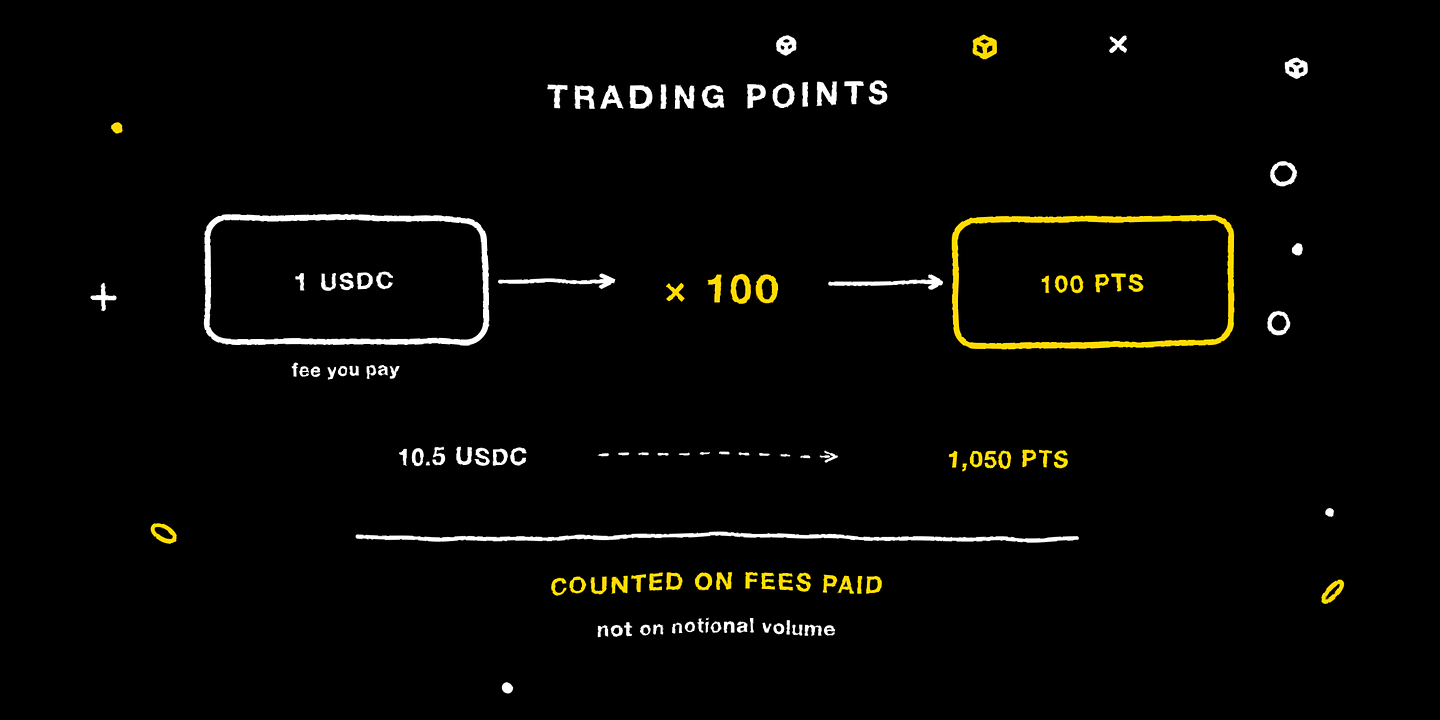
Trading Points earned = Trading Fees Paid × 100
A worked example. If you place a spot trade and pay $5 in trading fees, you earn 500 trading points. If, over a month, you've paid a cumulative $200 in fees across all your trading activity (spot, perpetuals, swaps), you've earned 20,000 trading points.
A few notes worth internalizing:
- The formula uses fees paid, not notional volume. Two traders with the same volume but different fee tiers will earn different points totals — fairly reflecting that one is contributing more revenue to the platform.
- All fee-paying activity counts. Spot trading fees, derivatives trading fees, and any other explicit trading fees roll up into the same points pool.
- All calculations are denominated in USDC. Whatever asset you actually pay your fees in, the system normalizes the value into USDC equivalent before applying the formula.
- Trading volume is calculated at the time the opening order executes. Points are credited the moment you open a position, not when you close it.
- Points are calculated daily. Trading and referral activity is aggregated daily and credited to your balance.
You don't need to optimize for points. If you're trading anyway, points accrue automatically. If you're not trading, no amount of "engagement" will manufacture them. That's the whole design.
3. Referral Points: A 10% Bonus on Your Invitees
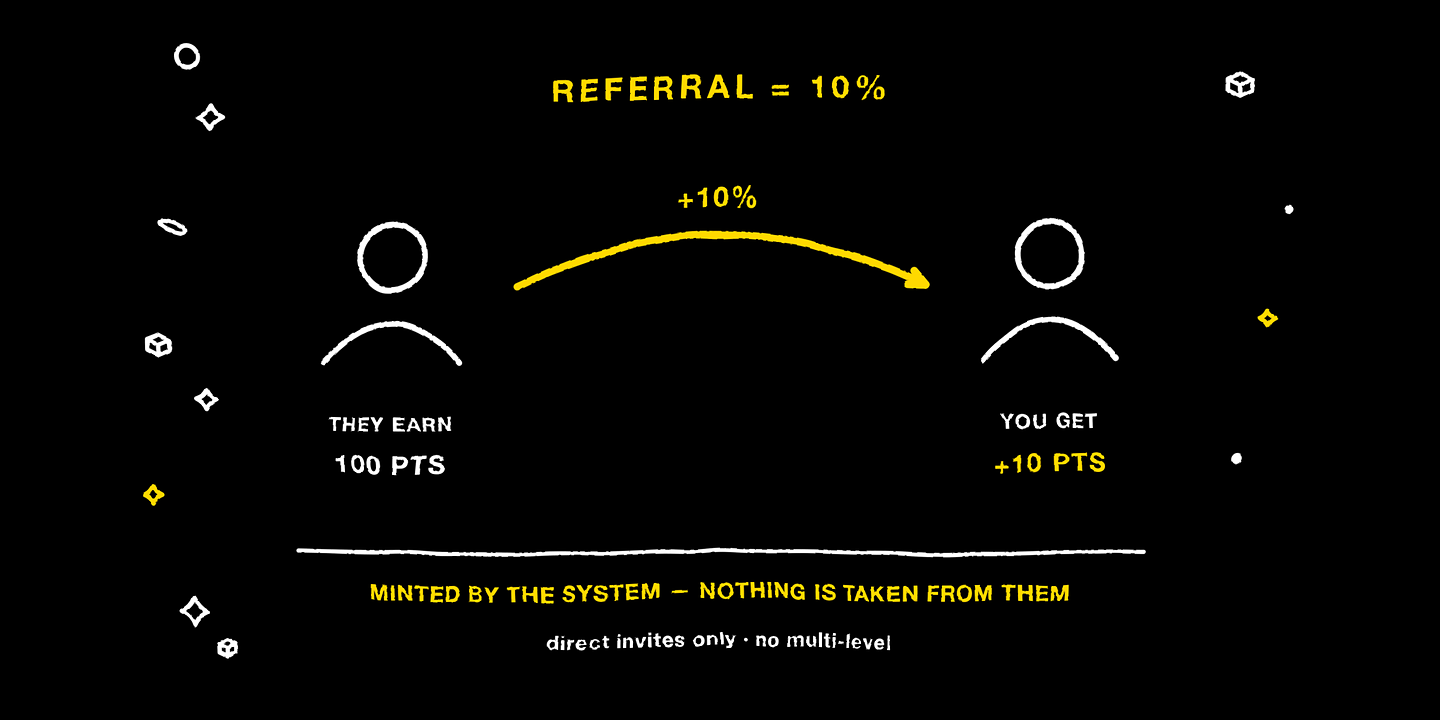
When you refer someone to the platform and they begin trading, you earn 10% of the points they earn — without those points being deducted from theirs.
So if your invitee earns 10,000 points in a month, you earn an extra 1,000 referral points — and they still keep their full 10,000.
A few practical implications:
- Direct referrals only — no multi-level. You earn 10% only on the activity of users you directly referred. Their referrals don't roll up to you. This is a single-tier program, not a pyramid.
- Multiple invitees aggregate. If you've referred several active users, your referral points equal 10% of the sum of all your direct referrals' points.
- Referral points are calculated daily, the same cadence as trading points.
- Quality of referrals matters more than quantity. Inviting one active trader can produce far more referral points than inviting fifty users who never trade.
- Referral points stack on top of your own trading points. They're added to the same balance and treated equivalently for leaderboard and airdrop purposes.
- The bonus is symmetric for the platform. Your invitee isn't punished — they earn their full points. The 10% comes from the platform's program budget, not from their balance.
The honest way to think about referrals: it's a way to share the program's value with people who would have benefited from the platform anyway. It's not a way to extract value from people you wouldn't otherwise have introduced to the platform.
4. Dynamic Decay: How "Tiered Conversion Efficiency" Actually Works
This is the mechanic most users misread on first encounter. The platform's documentation officially names it "dynamic decay", but the actual implementation isn't "old points lose value over time." It's "earning efficiency steps down once your daily points output exceeds a defined threshold."
The Mechanism: Tiered Conversion Efficiency
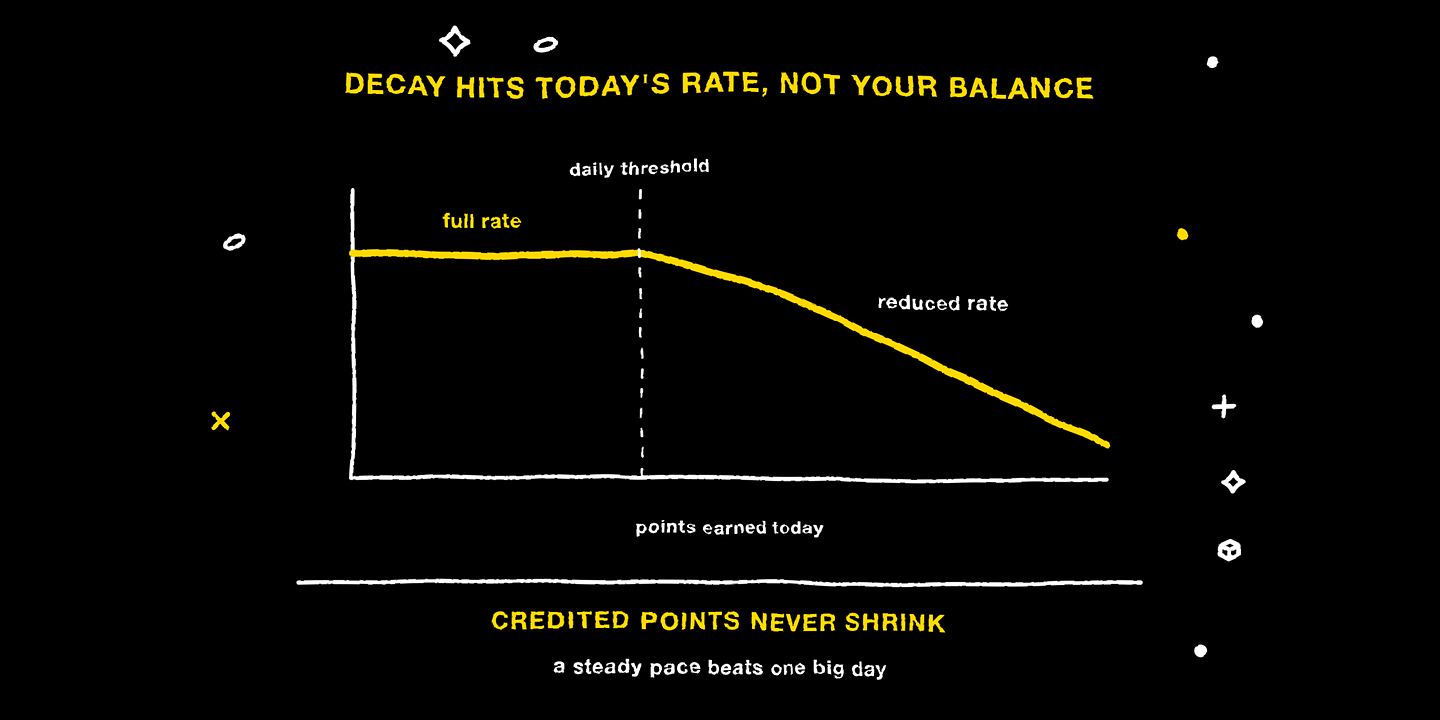
In one sentence: once your daily points output exceeds a defined threshold, points earned beyond that threshold are credited at progressively lower efficiency.
Concretely:
- Up to the daily threshold, points are calculated at full formula — Trading Fees × 100 — at 100% efficiency.
- Beyond the threshold, you continue earning, but each additional dollar of fees converts to fewer than 100 points, with efficiency declining algorithmically as output grows.
Important clarification: your previously earned points do not lose value over time. Decay applies to today's earning efficiency, not to yesterday's accumulated balance. This is the most important distinction from the common misreading that "old points fade away."
Why It's Designed This Way
The purpose is twofold:
- Prevent unlimited points inflation. Without this brake, a small number of high-frequency traders or automated strategies could pump enormous daily volume and dilute the points pool, making rewards worth less for everyone.
- Protect small and mid-sized traders. By tapering returns above a high-volume threshold, the system gives users with normal, steady participation a fairer share. This is a deliberate protocol choice in service of long-term sustainable growth.
The official wording: "The mechanism balances HFT output, ensures fair reward distribution, and prevents incentives from being disproportionately captured by a small number of automated strategies."
What It Means for You
- Even distribution beats burst activity. Cramming a week's trading into a single day is much less efficient than spreading it across seven days. This isn't a punishment — the tiered efficiency curve simply makes daily over-volume uneconomical on its own terms.
- Steady, consistent trading is the optimal strategy. Trading naturally each day, staying near or below the threshold, maximizes your conversion efficiency.
- The platform reserves the right to adjust thresholds. The official documentation explicitly states that the team can dynamically adjust point coefficients and decay thresholds in response to market conditions. Final parameters are governed by the latest official announcement and actual system settlement.
A Common Misreading, Cleared Up
Many users initially read "decay" as "the points I earned earlier will fade away." That's not how this platform's mechanism works. Points you've legitimately earned in the past are not eroded by the passage of time. The brake applies to earning efficiency on the day — specifically when your single-day output exceeds the threshold.
5. How to Maximize Points — Sustainably
A short, honest list. The first three are the only ones that matter:
- Trade the way you'd trade anyway. Don't manufacture trades for points; the fees will exceed the rewards' value, and the platform's anti-wash-trading systems flag patterns that look like points farming.
- Refer people who'd actually use the platform. A handful of real referrals beats a flood of inactive ones. Quality compounds; quantity doesn't.
- Stay engaged consistently — and avoid daily volume spikes. Tiered conversion efficiency makes evenly distributed activity earn at higher rates than bursty single-day pumps. Steady trading day-to-day always converts to more total points than a single concentrated session.
- Use the same account thoughtfully. Splitting activity across multiple accounts to "stack" points is detected and penalized by anti-cheat systems (covered briefly below).
There's no secret optimization. The most points are earned by people who would be active on the platform whether the program existed or not.
6. Anti-Cheat: Why This Section Exists
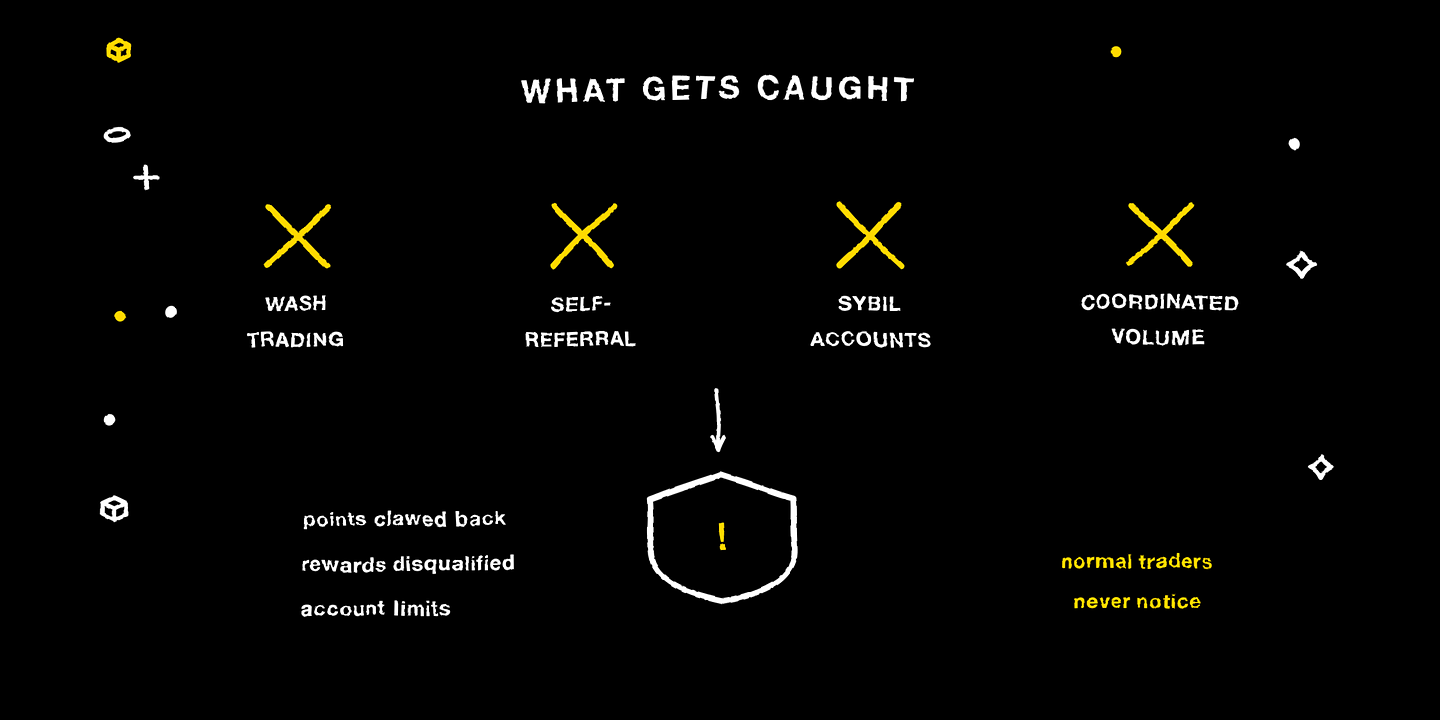
A brief note. The platform monitors for patterns that suggest points are being earned through illegitimate means rather than genuine trading: wash trading (trading with yourself across accounts), self-referral (creating new accounts to refer to your own primary), collusive trading (groups churning fees back and forth to stack points), and other manipulative activity.
When detected, these patterns can result in points being clawed back, accounts losing eligibility for current airdrops, and (in serious cases) account restrictions. The leaderboard and airdrop guides cover the monitoring layer in more detail.
For the vast majority of users — anyone trading normally — this is a non-event. It's mentioned here because the rules are clean: real activity is rewarded, simulated activity is not.
Trading Points - Calculated as Fees Paid x 100 (USDC denominated). Trading volume is counted when your opening order is executed.
Referral Points - Earn 10% of each direct referral's daily points. Points are calculated daily and apply only to direct referrals.
How Points Are Earned — Currently Available: Trading Points (from perpetual fees), Invite Count, Referral Commission (10% of referrals' points). Coming Soon: Position Points, KYC Points, Badges.
7. Quick Recap
Start Your Journey: Log in to the platform and embark on your points journey. Visit the [Task Center] to view the full task list and live rankings, and unlock your personalized path to growth. MCM token details will be announced separately. All terms are subject to official announcements.
Settlement and Adjustments: Points are automatically calculated when a trade occurs and are updated in the user's account in near real time. The MC Markets team reserves the right to dynamically adjust point coefficients and decay thresholds. All parameter updates are subject to the latest official announcements or the system's actual settlement results.
The four ideas worth keeping:
- Trading Points = Trading Fees Paid × 100. All calculations are denominated in USDC, points are credited at opening order execution, and balances are aggregated daily.
- Referral Points = 10% bonus on your invitees' points. Direct referrals only (no multi-level). The bonus is a separate budget — the invitee's balance isn't reduced.
- Dynamic decay (tiered conversion efficiency): earning rate steps down above a daily output threshold — designed to prevent points inflation and protect mid-sized traders. Past points do not lose value over time — the brake applies to today's earning efficiency, not your accumulated balance.
- The honest path is the optimal path. Real trading + real referrals + consistent engagement is not just compliant with the rules; it's also the most efficient way to accumulate points.
Risk Disclosure
The points program rules described here reflect current platform policy and may be updated; always check the official documentation for the latest parameters. Points and any associated rewards are not guaranteed financial returns and should not be the primary reason for trading. Trade only based on your own analysis and risk tolerance, with capital you can afford to lose.