
Market Liquidity and Trading Pace: How Liquidity Affects Your Fills and How to Place Large Orders
Market liquidity affects your fill price and how quickly your orders execute. Knowing this helps you place orders more sensibly in different market conditions.


1. What Is Market Liquidity?
Market liquidity is a measure of how easy it is to buy and sell an instrument.
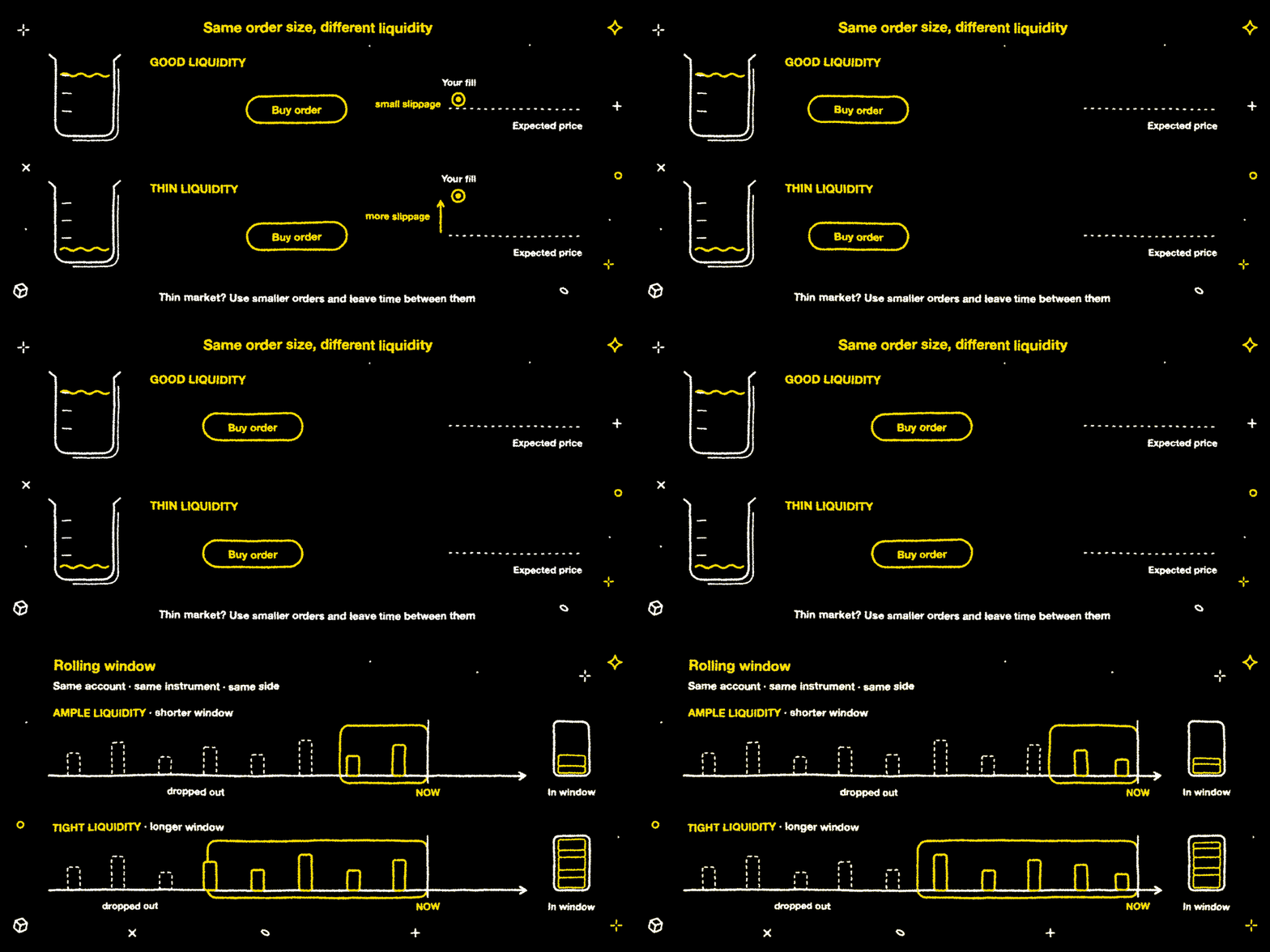
When liquidity is good, there are plenty of buyers and sellers in the market, and your order is more likely to fill quickly at a price close to what you expected. When liquidity is poor, fewer people are willing to trade with you, and a large order may face more slippage.
2. How Liquidity Affects Your Orders
The Trading notice below the order panel makes two points:
- Many same-direction trades in a short time can raise costs, and splitting an order does not lower the overall cost
- In sharp market moves, low liquidity or price-feed problems, orders may be re-quoted, rejected or time out
| Market conditions | What to do |
|---|---|
| Good liquidity | Trade normally |
| Tight liquidity | Reduce the size of each order, or leave more time between orders |
| Very low liquidity or sharp moves | Wait for liquidity to recover; you can still reduce or close positions whenever the market has an executable price |

3. Why Not Rush a Large Order When Liquidity Is Thin
If you place a large order in one go while liquidity is thin, you could be filled at a very unfavorable price. Waiting for liquidity to recover, or leaving more time between orders, gives you a better chance of a reasonable execution price.
4. Key Points to Remember
- Changes in market liquidity only affect new orders placed afterwards. They do not affect the positions you already hold.
- You can reduce or close positions whenever the market has an executable price.
- The platform will not force-close your existing positions because liquidity changes.
- Completed fills are not reversed because liquidity changes.
- The margin rate and maintenance margin of existing positions do not change because liquidity changes.

5. When Liquidity Can Change
| Situation | Possible impact |
|---|---|
| Major news events | Liquidity may drop sharply in the short term |
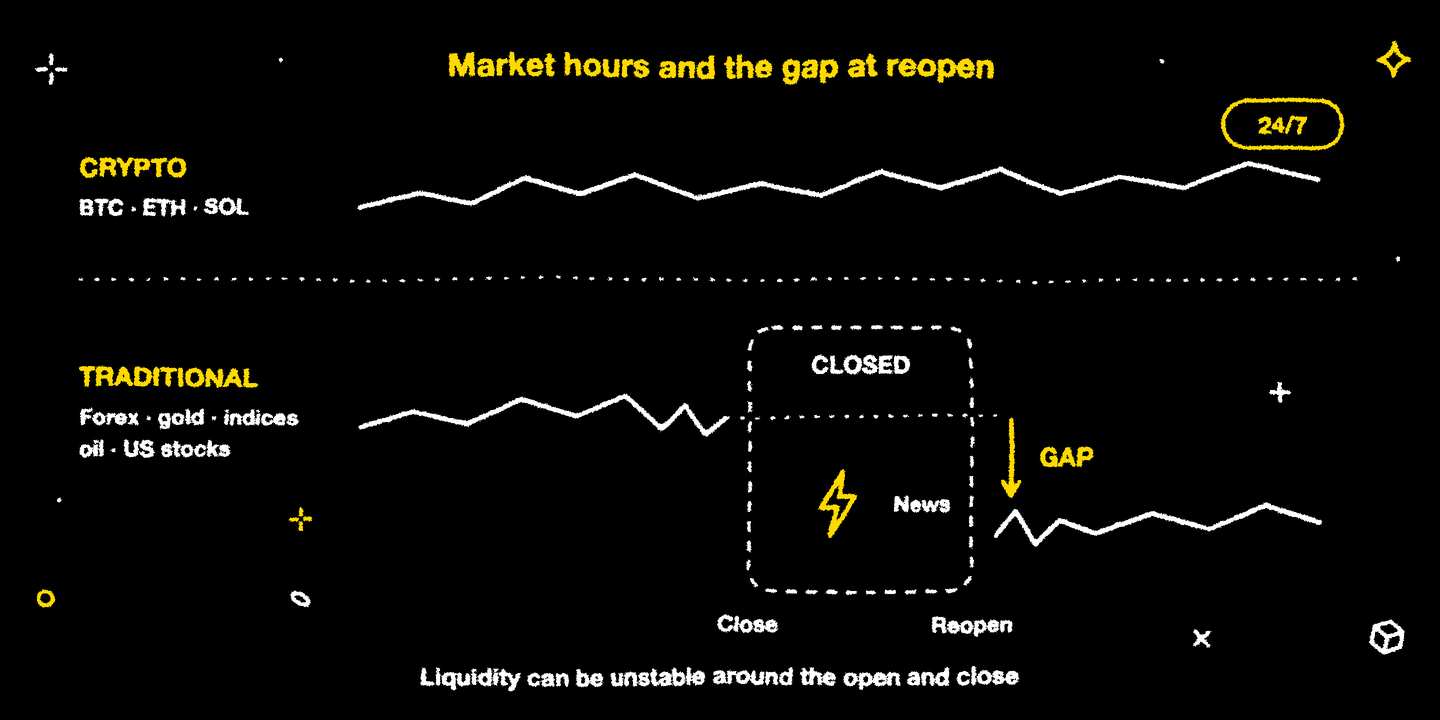
| Market close and open | Liquidity in traditional instruments may be unstable around the edges of their trading hours |
| Small-cap instruments | Liquidity may be naturally lower than in major instruments such as BTC and ETH |
| Late night and holidays | With fewer market participants, liquidity may fall |
| A single large order | One large order can use up the market depth currently available and briefly affect execution for the orders that follow |
A note on trading hours: crypto instruments can be traded 24/7, while traditional instruments such as forex, gold and silver, indices, crude oil and US stocks follow the opening and closing times of their real-world markets. While a market is closed, outside prices can move on news and events, so when it reopens the price may jump straight to a new level (a gap). You can find the hours under Trading Rules in the chart area of the trading page: click Trading hours GMT+8. While the market is closed, the order panel shows "Trading is currently closed" and the Market and Limit close buttons in the position list are greyed out, so assess the risk of your positions before the close.
6. If Liquidity Is Poor
Reduce your order size or leave more time between orders. Until liquidity recovers, waiting patiently is more likely to get you a reasonable execution price than forcing through a large order.
Further Reading
- Why Doesn't the Fill Price Match What You Expected? Dynamic Trading Spread, Market Slippage and Slippage Control
- Funding Rate Explained: Where It Comes From, Who Pays, and Why Day Traders Should Care
Risk Warning
Liquidity can drop sharply in a short time because of news, trading hours and other factors, large orders may face more slippage, and traditional instruments can gap when the market reopens. Only use funds you can afford to lose.
Disclaimer
This article is for general informational and educational purposes only and may not apply to the regulations or products available in your region. It does not constitute investment, financial, or trading advice of any kind, nor an offer, solicitation, or recommendation to buy, sell, or hold any digital asset.
Trading digital assets involves high risk, prices can be extremely volatile, and you may lose all of your invested capital. Leveraged trading can result in losses exceeding your initial deposit. Past performance is not indicative of, and does not guarantee, future results.
You should make investment decisions independently based on your own financial situation and risk tolerance, and consult a licensed professional adviser where necessary. While we strive to ensure the accuracy of the information in this article, MC Markets accepts no liability for any errors or omissions, or for any loss you may suffer from using or relying on this information.
No more