


Bitcoin traded at $82,159.07 on Friday, down 0.1% for the day as the cryptocurrency market stabilized after last week's volatility. The pullback from the recent high of $86,200 has been orderly, with buyers stepping in at each level of support. Market participants note that the correction has been relatively mild compared to previous cycles, suggesting that the market structure has matured significantly. The consistent demand at lower levels indicates strong institutional conviction, with traders viewing pullbacks as opportunities rather than signals of a trend reversal.
The recovery comes as institutional inflows cushion global market pressure. US spot Bitcoin ETFs recorded $180 million in net inflows this week, marking a sharp reversal from the $420 million outflows seen last week. Cumulative inflows since launch now stand at $18.4 billion. This swing in sentiment highlights the growing influence of institutional capital on Bitcoin price dynamics. Analysts point out that the rapid return of inflows after a single week of outflows demonstrates the underlying strength of demand, particularly from wealth management platforms and institutional allocators who continue to increase their exposure to digital assets.
Ethereum traded at $2,415, up 3.6% over 24 hours, outperforming Bitcoin. The broader crypto market cap rose 1.2% to $2.89 trillion, with most altcoins posting gains. Solana gained 4.8% to $132.50 and XRP rose 2.1% to $0.53. The altcoin strength suggests that risk appetite is returning to the broader digital asset market. Traders are rotating back into higher-beta names after a period of consolidation, with liquidity improving across major trading pairs. The correlation between Bitcoin and altcoins has remained elevated during this recovery phase.
Analysts note that Bitcoin's correlation with US equities has decreased in recent days, suggesting the cryptocurrency is developing its own independent drivers. The ETF flows and institutional adoption are providing a floor under the price that was not present in previous cycles. This decoupling is seen as a positive maturation signal, indicating that Bitcoin is increasingly viewed as a distinct asset class rather than a simple proxy for risk appetite. The growing institutional infrastructure, including custodial services and regulated trading venues, is helping attract a more diverse base of participants.
The options market shows increased demand for call protection, with the 25-delta skew shifting positive. Traders are paying more for upside exposure, reflecting optimism about further gains. Implied volatility has declined to 58%, down from 72% last week, suggesting reduced uncertainty. The decline in volatility indicates that market participants are becoming more comfortable with the current price range and expect continued stability. The positive skew suggests that demand for calls is outpacing demand for puts, which typically indicates that traders are positioning for upside rather than hedging against further downside.
On-chain data shows that long-term holders continue to accumulate, with wallets holding Bitcoin for over a year adding to positions. Exchange outflows have increased for three consecutive weeks, suggesting investors are moving coins to cold storage rather than preparing to sell. This pattern of accumulation by long-term holders is historically associated with bullish market phases, as it reduces the circulating supply available for trading. The sustained exchange outflows also indicate a growing preference for self-custody, which reduces selling pressure and limits the potential for large liquidations in the event of market stress.
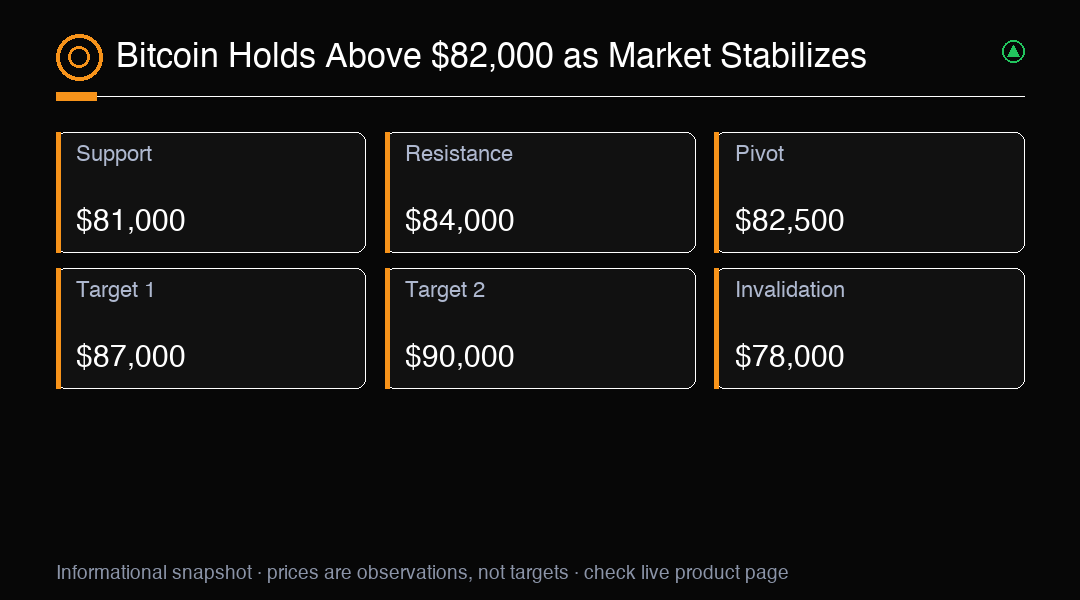
From a technical perspective, Bitcoin is now testing a key support zone between $81,000 and $82,000. A decisive break below $81,000 could open the door to a retest of $78,000. Conversely, a reclaim of $84,000 would signal a return to the recent uptrend. The current price action is forming a consolidation pattern that could resolve in either direction. Traders are watching the volume profile to determine whether the support zone will hold, as high-volume breakout attempts tend to be more reliable than low-volume moves in either direction.
The gold-silver ratio in crypto terms, measured by the BTC/ETH ratio, has stabilized at 34.0, suggesting Ethereum is gaining ground relative to Bitcoin. This could indicate a broader altcoin season if the trend continues. The ratio has been declining gradually since the start of the quarter, reflecting improved sentiment toward smart contract platforms and decentralized applications. Traders monitor this ratio closely as a gauge of relative strength between the two largest cryptocurrencies, and a continued decline could signal a shift in capital rotation from Bitcoin into alternative digital assets during the current market cycle.
Looking ahead, Thursday's PPI report could provide a catalyst for Bitcoin. If inflation data comes in cooler than expected, it could ease rate pressure and lift risk assets including cryptocurrencies. Conversely, another hot reading could push Bitcoin below $82,000. The relationship between inflation data and crypto prices has strengthened in recent months as institutional investors increasingly view Bitcoin as a hedge against currency devaluation. The PPI report is particularly important because it captures input costs before they reach consumers, providing an early signal of potential consumer price pressures.
Overall, Bitcoin appears to be consolidating in a broad range between $78,000 and $87,000. The ETF inflows and declining volatility suggest the market is maturing, with institutional investors providing more stable support than in previous cycles. The current consolidation phase is characterized by lower volatility and narrower trading ranges, which often precede significant price moves in either direction. Market participants are waiting for a clear catalyst to determine the next trend, with the upcoming macroeconomic data and regulatory developments likely to play key roles in shaping Bitcoin's trajectory over the coming weeks.
Some analysts are now targeting $90,000 as the next major resistance level, arguing that the combination of ETF demand and macroeconomic uncertainty could drive Bitcoin to new highs by year-end. The $90,000 level represents a psychological barrier and a natural target for bulls who believe the current market cycle has further to run. The convergence of institutional adoption, favorable macro conditions, and increasing retail interest could create the necessary momentum to push Bitcoin beyond its previous all-time high, with $90,000 serving as a key waypoint on the way to potentially higher levels.
Derivatives market data reinforces the cautiously optimistic outlook, with funding rates remaining neutral and open interest steady across major exchanges. The absence of excessive speculative positioning in the futures market suggests that the current price action is driven by spot demand rather than derivative-led activity, which historically leads to more sustainable price movements. Market makers report balanced order flow between bids and asks, with no single large participant dominating the order book. This balanced market structure suggests that the consolidation phase could continue in the near term, with a resolution likely to come from external catalysts rather than internal market dynamics.
Trading Insight
Bitcoin is stabilizing above $82,000 with ETF inflows providing support. Watch $81,000 support and $84,000 resistance. Range remains $78,000 to $87,000.