


Gold rose to $4,156 per ounce on October 15, up 1.23% from the previous day, extending a rebound that has seen the precious metal gain 2.4% over the past week. The advance came despite a firmer dollar earlier in the session, suggesting other factors are firmly supporting the market. Bullion has now climbed for three consecutive sessions, with buyers stepping in at each pullback to defend short-term moving averages. The move higher also reflects renewed safe-haven demand amid persistent geopolitical uncertainty across multiple regions.
The gain follows a US producer inflation report that came in cooler than expected, easing concerns about aggressive Federal Reserve rate hikes. The producer price index rose less than forecast in September, marking the softest reading in five months and reinforcing bets that the central bank is nearing the end of its tightening cycle. The dollar index fell 0.3% to 101.20, making gold cheaper for foreign buyers and boosting demand across international markets. Treasury yields also declined, with the 10-year note slipping below 4.00% for the first time since August, further easing the opportunity cost of holding non-interest-bearing assets like gold.
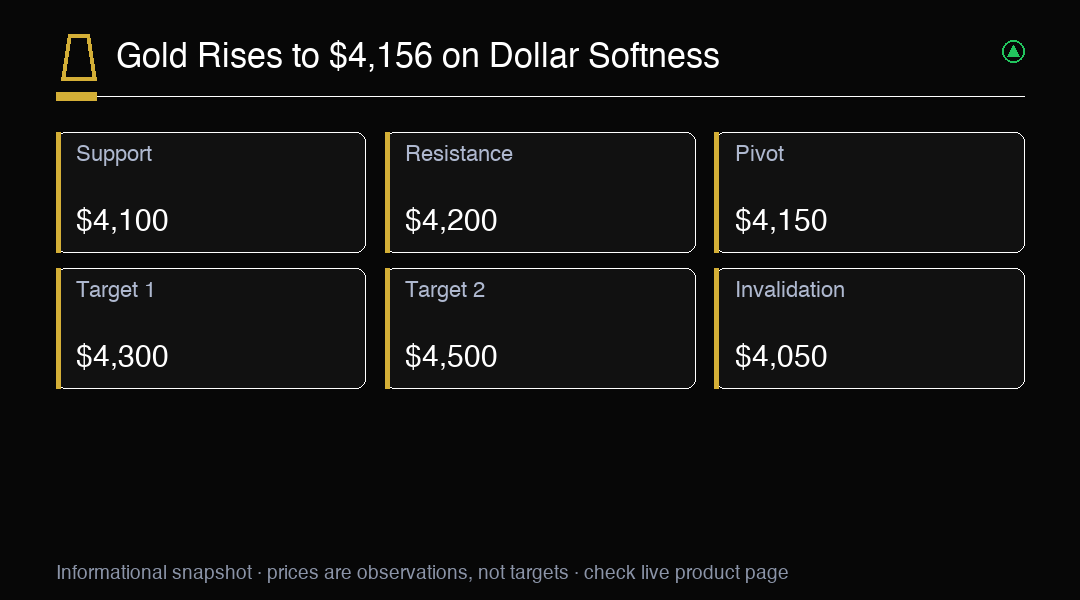
Gold has now recovered from the recent low of $4,050 set earlier this month. The metal remains up 35% year over year, though it is down 4% from the all-time high of $5,608.35 set in January 2026. Key resistance is now seen at $4,200, a level that drew selling interest in late September when prices briefly spiked above that mark before reversing sharply. Market technicians note that a sustained close above $4,200 would be needed to confirm a breakout. The metal's performance in coming days will likely determine whether the current rebound evolves into a sustained uptrend or another failed attempt to reclaim lost ground.
From a technical perspective, gold is testing a resistance zone between $4,150 and $4,200. A decisive break above $4,200 could open the door to a retest of $4,300. Conversely, a pullback below $4,100 would signal a return to the recent trading range. The 50-day moving average at $4,130 is providing dynamic support, while the relative strength index is approaching overbought territory, suggesting the rally may be stretched in the near term. Volume has been modest during the recovery, which some analysts interpret as a lack of conviction among institutional participants.
Silver also rallied, gaining 1.8% to $49.20 per ounce. The gold-silver ratio fell to 84.5, its lowest level in three months, suggesting silver is outperforming gold during the current bout of risk appetite. Silver has historically led precious metals during periods of economic recovery, and its relative strength is being read by some technicians as a constructive signal for the broader complex. Platinum also gained ground, rising 0.9% to $1,620 per ounce, while palladium added 1.2% to $1,180. The broad-based strength across the precious metals complex suggests investors are rebuilding exposure after the recent pullback.
Analysts note that gold's recent strength is somewhat surprising given the macro environment. Rising government deficits and elevated geopolitical tensions should be supportive, but the metal had struggled to gain traction until the latest inflation data provided a catalyst. Real yields remain elevated by historical standards, which typically reduces the appeal of non-interest-bearing assets like gold. The fact that bullion is rising despite this headwind is seen as evidence of underlying demand from both official sectors and private investors. Some strategists believe this marks a structural shift in how the market prices monetary policy expectations.
Investment flows into gold-backed exchange-traded funds have improved in recent weeks, reversing a multi-month trend of outflows. Data shows that global gold ETF holdings increased by 12 tonnes in the week ending October 12, led by North American products. Retail interest has also picked up, with bullion dealers reporting stronger demand for coins and small bars. This shift in positioning suggests investors are rebuilding exposure to the metal after earlier profit-taking. The return of ETF demand is particularly notable because institutional flows were a primary driver of gold's surge to record highs earlier in 2026.
The options market shows increased demand for call protection in gold, with implied volatility rising to 19.2%, up from 16.8% last week. Traders are paying more for upside exposure, reflecting optimism about further gains. However, put skew remains negative, suggesting some investors are still hedging against declines. Open interest in call options at the $4,200 strike has increased notably ahead of the next consumer inflation report. This positioning suggests that while the near-term momentum favors the upside, market participants remain cautious about the sustainability of the rally.
Central bank buying continues to provide a floor under gold. The World Gold Council reported that central banks added 28 tonnes to reserves in October, with China, India and Poland leading the purchases. This follows record buying in 2024 and 2025, when official sector demand exceeded 1,000 tonnes for consecutive years. Central bank demand has been a key structural driver of the bull market, providing consistent absorption of mine supply. The official sector's accumulation is driven by a desire to diversify away from the US dollar and hedge against geopolitical risk, a trend that shows no signs of slowing.
Looking ahead, Thursday's retail sales data could influence gold prices. If consumer spending comes in stronger than expected, it could boost rate pressure and weigh on precious metals. Conversely, weak retail sales could ease rate concerns and lift gold. The report is particularly important because Fed officials have repeatedly emphasized that policy decisions will depend on incoming data. A softer print would reinforce the market's growing conviction that the tightening cycle is complete, while a stronger reading could reignite hawkish expectations and trigger another round of selling.
Overall, gold remains in a broad range between $4,050 and $4,300 established over the past month. The combination of cooler inflation and dollar softness has provided near-term support, but sustained gains will likely require confirmation that the Fed is pausing its rate hikes. Market participants will also be watching upcoming speeches from Federal Reserve officials for further guidance on the policy path. The next consumer price index release is due next Tuesday and could provide the next major catalyst for directional movement.
Some analysts are now targeting $4,500 as the next major resistance level, arguing that the combination of ETF demand and macroeconomic uncertainty could drive gold to new highs by year-end. However, caution is warranted given the metal's sharp reversal from earlier highs in 2026. A more conservative scenario sees gold consolidating in the current range until the Fed signals a definitive end to its tightening campaign. Either way, the coming weeks are likely to set the tone for gold's performance through the fourth quarter and into 2027.
Trading Insight
Gold is testing $4,200 resistance after rebounding from $4,050 support. Watch Thursday's retail sales data. Range remains $4,050 to $4,300.