
The Perpetual Trader's Handbook
A practical, end-to-end manual for trading perpetuals on this platform — markets, leverage, the order book, the four essential orders, PNL math, and the total cost of every trade.


Introduction
Perpetuals are the most-traded derivative product in crypto, and the same instrument now extends to gold and forex on this platform. They're powerful, capital-efficient, and unforgiving. Understanding the model — before placing your first trade — matters more than getting any single trade right.
This handbook walks you through the full picture: what perpetuals are, how prices are constructed, the order types you'll actually use, the math behind PNL and total equity, and the costs (visible and invisible) that shape your real returns.
1. What Is a Perpetual Contract?
A perpetual is a derivative that lets you take a leveraged long or short position on an asset, without ever owning the asset itself, and without an expiry date.
Derivative. You trade an agreement that tracks the underlying — bitcoin, gold, a forex pair — not the asset itself.
Leveraged. You post a small fraction of the position's value as collateral; the platform extends the rest. A move in the underlying translates into a much larger move on your collateral.
Long or short. Profit from prices going up or down with the same instrument.
No expiry. Hold for as long as you maintain enough margin. The mechanism that makes this work is the funding rate — covered in section 5.
For active traders, perpetuals offer maximum capital efficiency, two-way directional exposure, and no expiry-roll mechanics — at the cost of actively managing margin and funding.
Multi-asset trading
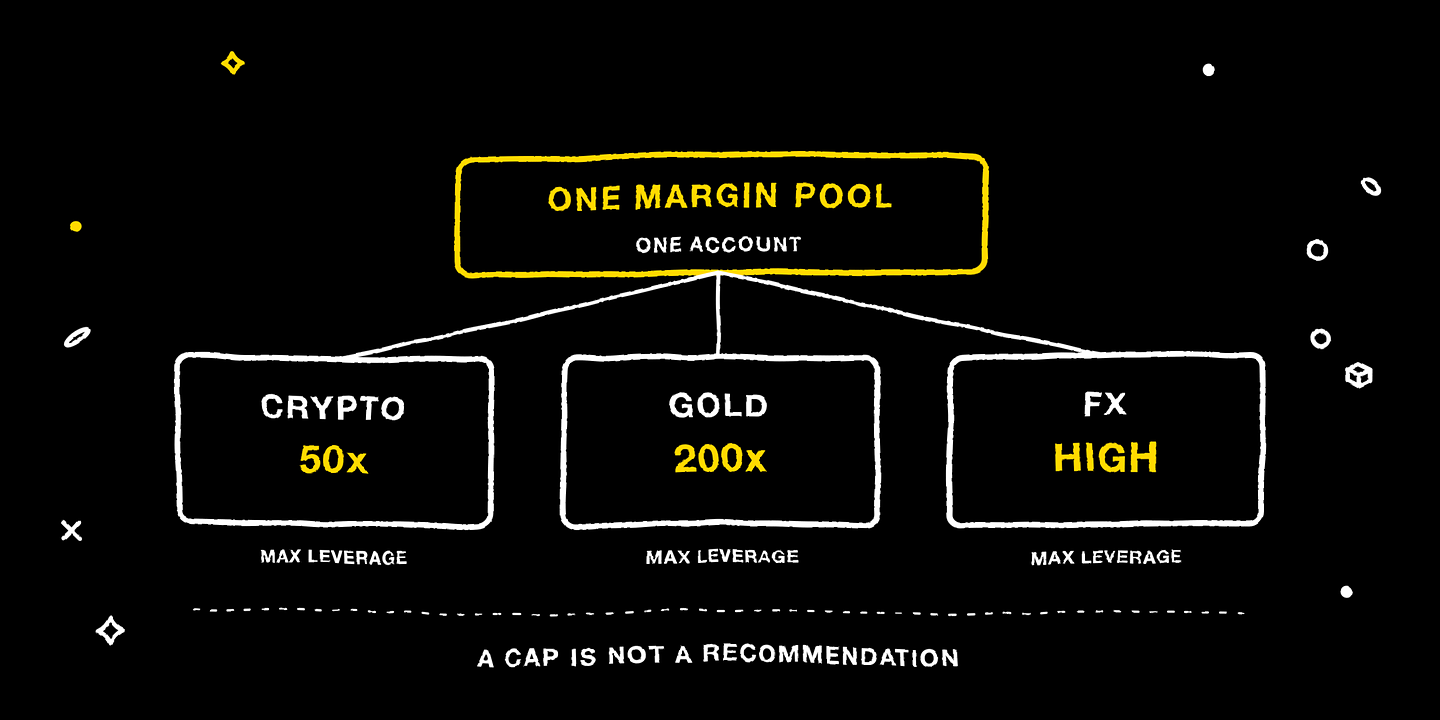
The same account, interface, and risk tools work across three asset classes:
Crypto perpetuals (BTC, ETH, altcoins) — most volatile, deepest 24/7 liquidity.
Gold perpetuals — exposure to spot gold without holding physical or paying storage; deep institutional liquidity.
Forex perpetuals — major currency pairs; lowest volatility, most competitive pricing of the three.
One account, one collateral pool, three markets — instead of fragmenting capital across separate brokers.
Leverage limits and the floating tier system
Typical maximums:
Crypto: up to 50x
Gold: up to 200x
Forex: also high, asset-specific
Gold and forex offer higher leverage because they're less volatile per unit of time — a given amount of margin protects against more "normal market noise."
Two nuances matter:
The maximum is not the recommendation. Higher leverage means a smaller buffer between your entry and your liquidation price.
Maximum leverage steps down as your position size grows. This is the floating leverage tier system — a built-in protection against whale-sized positions getting liquidated against thin order books. Always check the tier table before scaling into size. (See the Margin & Liquidation guide for full mechanics.)
2. How Prices Are Constructed
Prices on a derivatives platform aren't a single number. At any moment there are at least four prices in play.
Bid, ask, and mid
The order book is two queues sorted by price:
Best bid — highest price any buyer is offering.
Best ask — lowest price any seller is asking.
Mid Price = (Best Bid + Best Ask) / 2.
When the best bid and best ask sit close together, liquidity is deep and pricing is competitive. When they sit far apart, liquidity is thin, conditions are fast-moving, or both.
Market depth and impact cost
The best bid and ask are only the surface — behind them sit dozens or hundreds of orders at progressively worse prices. This stack — market depth — determines how an order of meaningful size will execute.
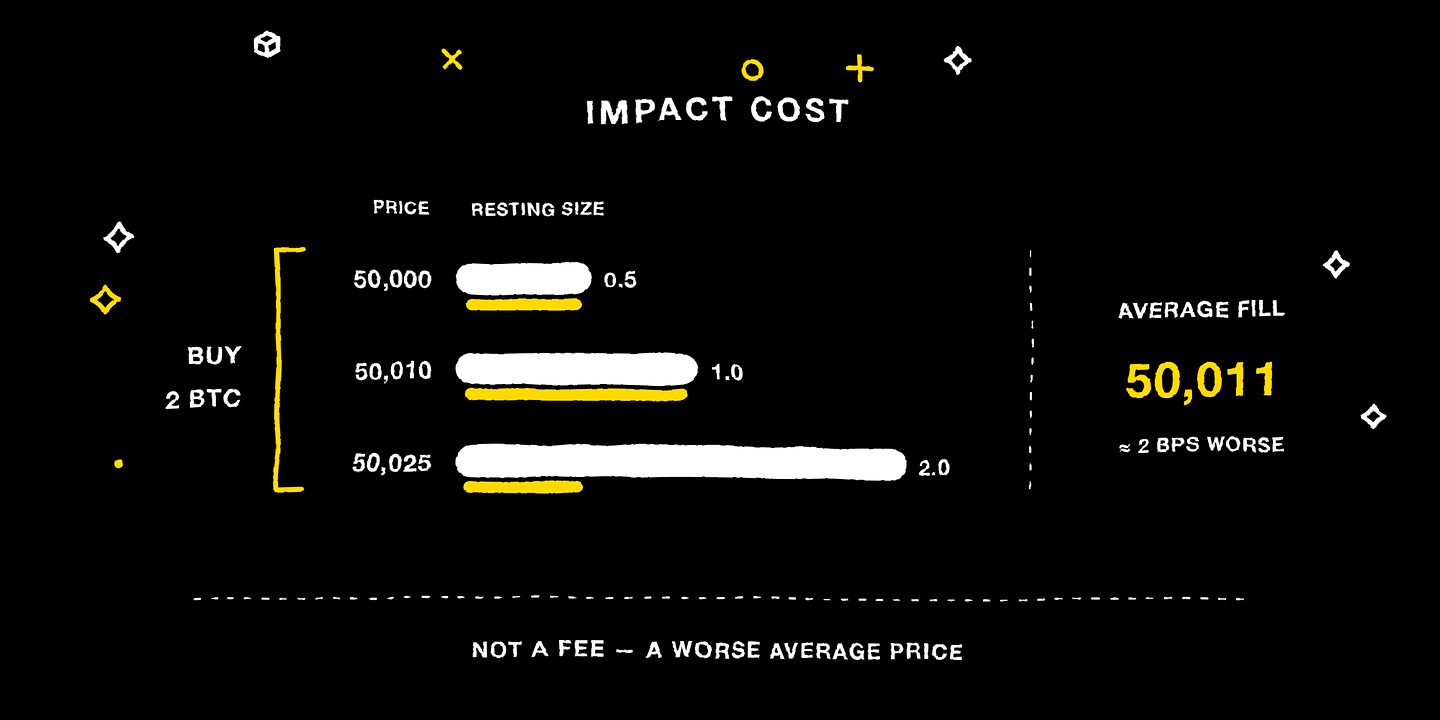
When you market-buy more than the top-of-book size, your order walks the book, eating successive levels at progressively worse prices. The difference between the price you'd have paid for an "infinitely small" trade and your actual average fill is the impact cost.
A quick example. If the order book ladder is $50,000 / $50,010 / $50,025 with 0.5 / 1.0 / 2.0 BTC at each level, market-buying 2 BTC fills at an average of about $50,011 — roughly 2 basis points worse than the best ask. That gap is your impact cost. Two things to internalize:
Impact cost grows non-linearly with size relative to depth.
It doesn't show up as a fee — it shows up as a worse average fill.
The mark price formula
The Mark Price is the platform's fair-value reference. It's used to calculate unrealized PNL, decide liquidations, and set funding rates. It is not simply the last traded price — last price can be moved by a single large taker or by a momentary anomaly.
The construction this platform uses:
The Mark Price is the platform's fair-value reference, generated by a proprietary algorithm combining internal data and external oracle data (Chainlink and Pyth) to produce a Fair Aggregated Price — more manipulation-resistant than any single traded price. It is used for PNL calculation, liquidation triggers, and funding rate setting.
Execution quote (one-click price) formula:
Buy: QuoteAsk = MarkAsk + ImpactPrice(N)
Sell: QuoteBid = MarkBid − ImpactPrice(N)
The mid anchors fair value to the current order book; ImpactPrice adjusts for order-size liquidity cost. Your liquidation will not be triggered by a single rogue print.
The mid anchors fair value to the current top-of-book; the impact cost adjustment makes mark price robust to thin top-of-book quotes that don't represent real liquidity. Your liquidation isn't decided by a single rogue print.
Slippage tolerance
Your fill can land away from the price you expected. It comes from (1) price moving between decision and fill, and (2) walking the book.
The platform's slippage tolerance rejects orders that would fill more than your defined deviation. Defaults: 8% spot, 10% derivatives. Tighten in calm markets for stronger protection; leave looser when speed matters.
3. The Four Essential Order Types
Four orders handle 95% of real trading.
Market Order — fills now at the best available price. Use when getting in or out now matters more than the exact price. Watch for impact cost on size.
Limit Order — fills only at your price or better; otherwise waits. Use for precise entries, large size, or to qualify for maker fees. Trade-off: not guaranteed to fill.
Stop-Loss — a conditional order that triggers at your "I'm wrong" price and exits the position automatically. Use it on every leveraged position — the single most important risk tool a trader has. Note: it guarantees an exit attempt, not an exit price; in fast moves the actual fill can be worse than the trigger.
Take-Profit — the mirror of a stop-loss; triggers when price hits your target.
A clean trade typically uses three together: an entry (market or limit), a stop-loss sized so a single losing trade doesn't exceed 1–2% of the account, and a take-profit at a level that gives at least 1:2 reward-to-risk versus the stop. Combine stop and take-profit as OCO (One-Cancels-the-Other) — whichever side hits first cancels the other. When all three are defined before you click confirm, the trade no longer depends on emotional decisions made in real time.
4. PNL: The Number on Your Screen
Two kinds of PNL: unrealized (the position is still open; floats with the market) and realized (the position is closed; the number is final).
The core formula
Long: Unrealized PNL = (Mark Price − Entry Price) × Position Size
Short: Unrealized PNL = (Entry Price − Mark Price) × Position Size
Three variables:
Entry Price — the average price your current position was opened at (weighted average across multiple fills).
Mark Price — the fair-value reference (section 2). Not the last traded price.
Position Size — quantity of the underlying. Always confirm what unit the platform shows.
Worked examples
Long 0.5 BTC at $50,000. If mark moves to $52,000:
PNL = (52,000 − 50,000) × 0.5 = +$1,000
Short 1 ETH at $3,000. If mark drops to $2,800:
PNL = (3,000 − 2,800) × 1 = +$200
For shorts the formula simply flips (Mark − Entry) to (Entry − Mark). The intuition is identical: PNL is positive when the market moves in your favor.
PNL ≠ ROE
These are two different numbers, often confused.
PNL is the dollar amount made or lost.
ROE is PNL ÷ margin you put up — not ÷ notional.
The long BTC example: $1,000 PNL on a $26,000 notional. At 10x leverage, your margin was $2,600. ROE = $1,000 / $2,600 ≈ +38%. A 4% price move became a 38% return on margin. PNL describes the trade; ROE describes what the trade did to your capital.
Total account equity
Individual position PNL is one piece of a bigger number:
Total Equity = Wallet Balance + Sum of All Unrealized PNL
Available Balance = Total Equity − Margin Used by Open Positions − Margin Reserved for Open Orders
Available balance is what you can use to open new positions or withdraw. As your unrealized PNL changes, your available balance changes — your "buying power" can shrink during a drawdown even with no new trades.
5. The Total Cost of Trading
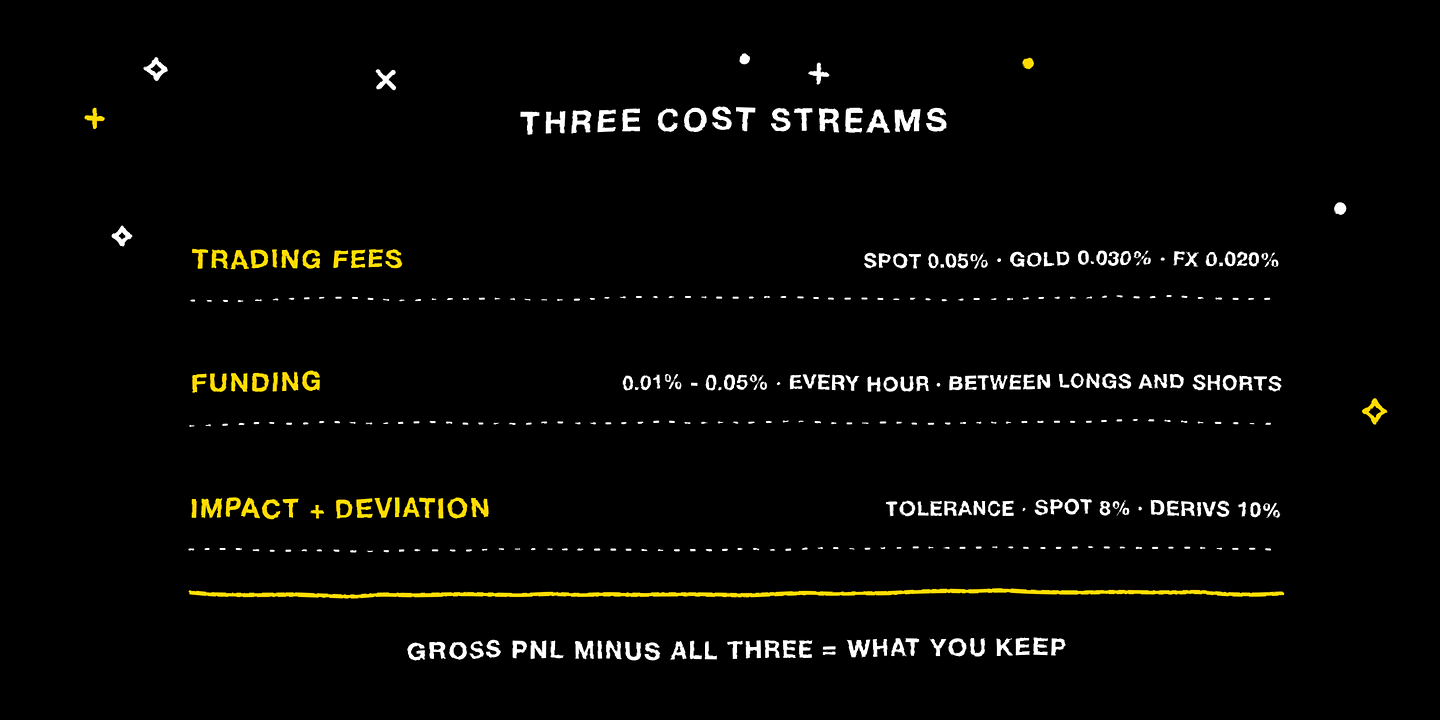
The PNL formula gives you the gross number. Net depends on three cost streams.
Trading fees
Charged on each side of the trade, calculated on notional value (not margin). Standard rates on this platform:
Spot: 0.05%
Gold: 0.030%
Forex: 0.020%
These rates sit at the low end of the industry. If the platform offers maker/taker pricing, limit orders that wait to be filled (makers) typically get a lower rate than market orders that take liquidity (takers). Shifting volume from taker to maker is one of the highest-impact ways to reduce real cost.
Funding rates (perpetuals only)
Perpetuals don't expire, so a funding rate mechanism anchors contract prices to spot. Every hour, longs and shorts exchange a small payment based on the current rate:
Funding positive → longs pay shorts.
Funding negative → shorts pay longs.
The exchange itself doesn't take this — it flows directly between traders. But it absolutely affects your real return on a held position. Per interval the rate is small (often 0.01%–0.05%), but it compounds; a long held through several days of consistently positive funding can pay 1–2% of notional in carry alone. Always check the funding rate before holding overnight.
Impact cost and fill deviation
Already covered in section 2. In thin markets, the gap between your expected and actual fill on a market order can dwarf the trading fee. Use limit orders for size; tighten slippage tolerance in calm markets.
Risk monitoring (not a fee, but it matters)
The platform runs continuous monitoring — checking margin ratios in real time, auto-adjusting leverage tiers as size grows, flagging manipulative patterns, and applying circuit breakers in extreme volatility. None of this is "free" (it's funded by the same fees you're paying), but its benefit is structural: orderly liquidations, healthier insurance fund, more competitive pricing, fairer fills.
6. A First Trade, Step by Step
What placing one actually looks like:
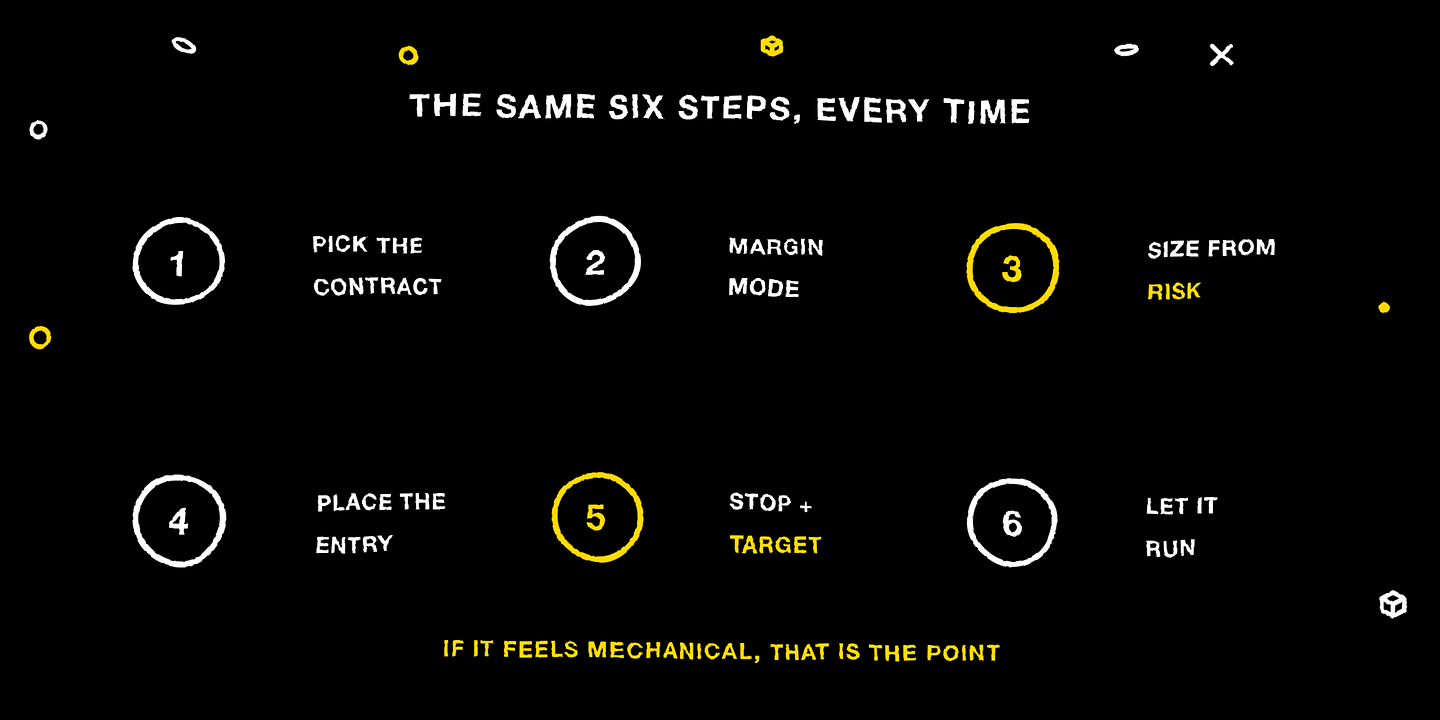
Choose the contract — confirm USDT-margined vs coin-margined.
Pick margin mode — isolated for speculative trades; cross only when you understand correlation across positions. (See the Margin & Liquidation guide.)
Set leverage and size by risk, not by leverage. Decide the dollar loss you'll accept on this trade. Reverse-engineer position size so your stop-loss being hit equals exactly that loss. Leverage is a consequence of size and stop distance, not a target. Many experienced traders use 3x–10x on directional crypto trades, far below the cap.
Place the entry — limit if you have a level; market if timing matters more than price. Set slippage tolerance.
Place stop-loss and take-profit immediately — before you go anywhere. An open position without a stop is the single most common way unfunded losses become account-ending losses.
Monitor — don't manage. Resist moving your stop wider when price approaches it. Close on plan or by your pre-defined rules.
If this feels mechanical and unexciting, that's the point. Profitable perpetual trading is mostly the same handful of steps repeated correctly thousands of times.
7. Common Beginner Mistakes
Five patterns that account for most early account blow-ups:
Maxing leverage to "make more." Higher leverage doesn't earn more — it just narrows your buffer. Same trade, lower leverage = same dollar PNL but much wider safety margin.
Trading without a stop-loss. Hope is not a strategy.
Adding to losing positions. Doubling down to "average down" turns a small loss into a large one. Add to winners; cut losers.
Ignoring funding rates. Persistent positive funding can cost more than the price move itself.
Confusing PNL with ROE. A 10x leveraged trade "down 10%" on margin is only down 1% on price. Know which number you're looking at.
Further Reading
What Are Perpetual Contracts? Leverage, Shorting, and the Funding Rate
What Is Liquidation? Understanding MC Markets' Liquidation Mechanics and Margin Calls
8. Quick Recap
The five ideas worth keeping:
Perpetuals = leveraged, no-expiry contracts that track an underlying. Funding rates every hour keep prices anchored to spot. Multi-asset support: one account, one collateral pool, three markets.
The Mark Price is the platform's fair-value reference, generated by a proprietary algorithm combining internal data and external oracle data (Chainlink and Pyth) to produce a Fair Aggregated Price — more manipulation-resistant than any single traded price. It is used for PNL calculation, liquidation triggers, and funding rate setting.
Execution quote (one-click price) formula:
Buy: QuoteAsk = MarkAsk + ImpactPrice(N)
Sell: QuoteBid = MarkBid − ImpactPrice(N)
The mid anchors fair value to the current order book; ImpactPrice adjusts for order-size liquidity cost. Your liquidation will not be triggered by a single rogue print.
Four orders cover 95% of trading: Market, Limit, Stop-Loss, Take-Profit. Open every perpetual position with a pre-defined stop-loss.
PNL = (Mark − Entry) × Size for longs; flip for shorts. Total Equity = Wallet + Sum of Unrealized PNL. ROE ≠ PNL.
Total cost = trading fees (0.05% / 0.030% / 0.020%) + funding + impact cost / fill deviation. Use limit orders for size, tighten slippage tolerance in calm markets, check funding before holding overnight.
Appendix: Contract Specifications & Fee Schedule
| Instrument | Contract Size | Minimum Tick | Price Precision | Quantity Precision | Minimum Order (Notional/USD) | Minimum Quantity |
|---|---|---|---|---|---|---|
| BTCUSDC | 1 | 1.0 | Integer | 0.001 | $10 | 0.001 |
| ETHUSDC | 1 | 0.1 | 1 decimal | 0.01 | $10 | 0.01 |
| SOLUSDC | 1 | 0.01 | 2 decimals | 1 | $10 | 1 |
| XAUUSD | 1 oz | 0.001 | 3 decimals | 1 | $100 | 1 |
| XAGUSD | 1 oz | 0.00001 | 5 decimals | 50 | $100 | 50 |
| Forex Majors | 1 base currency unit | 0.0001 (USDJPY 0.01) | 4 decimals (JPY=2) | 1000 | $1,000 | 1000 |
| Indices (US500 etc.) | 1 index point | 1 | Integer | 0.01 | $100 | 0.01 |
| USOIL | 1 bbl | 0.001 | 3 decimals | 10 | $100 | 10 |
| US Stocks | 1 share | 0.00001 | 5 decimals | 1 | $10 | 1 |
Contract Value & Asset Units
Non-Crypto Perpetuals Fee Schedule
| Asset Class | Examples | Total Rate (Per Leg) | Open | Close |
|---|---|---|---|---|
| Gold | XAUUSD | 0.030% | 0.015% | 0.015% |
| Silver | XAGUSD | 0.100% | 0.050% | 0.050% |
| Forex (Majors) | EURUSD... | 0.020% | 0.010% | 0.010% |
| Indices | US500/NAS100... | 0.050% | 0.025% | 0.025% |
| Energy | USOIL | 0.100% | 0.050% | 0.050% |
| US Stocks | TSLA | 0.100% | 0.050% | 0.050% |
Crypto Perpetuals Tiered Fee Schedule
| Tier | 14D Weighted Volume (USD) | Total Rate (Per Leg) | Open | Close |
|---|---|---|---|---|
| Base | 0 | 0.030% | 0.015% | 0.015% |
| 1 | > 5M | 0.026% | 0.014% | 0.014% |
| 2 | > 25M | 0.0215% | 0.01075% | 0.01075% |
| 3 | > 100M | 0.017% | 0.0085% | 0.0085% |
| 4 | > 500M | 0.014% | 0.007% | 0.007% |
| 5 | > 2B | 0.013% | 0.0065% | 0.0065% |
| 6 | > 7B | 0.012% | 0.006% | 0.006% |
Risk Disclosure
Perpetual contracts and other leveraged products carry substantial risk and can result in losses exceeding your initial deposit. The mechanics, fees, and risk parameters described here reflect the platform's current implementation and may be updated; always consult the official documentation before trading. Past performance does not guarantee future results. Trade only with capital you can afford to lose, and consult a qualified financial advisor if you are unsure whether leveraged products are appropriate for your situation.
No more