
Yield, Two Ways: Flexible Earn and the MLP Vault
Two yield products, two different roles. Earn — flexible, low-risk yield on 5 assets, no lock-up. Vault — higher-yield USDC liquidity partnership, 4-day lock. How each one works, when to use which, an


Introduction
Most people hold some crypto that sits still for long stretches — BTC kept for the long term, USDC waiting between trades, ETH staked mentally rather than actively traded. Idle capital is unproductive capital. This platform offers two yield products designed to put that idle capital to work, each built around a different trade-off:
Earn — the flexible, low-risk option. Deposit any of 5 supported assets, accrue daily yield, withdraw any time without penalty.
Vault (MLP) — the higher-yield option. Deposit USDC, become a liquidity partner sharing in the platform's trading-fee revenue, accept a 4-day lock-up.
This guide explains both products in detail and then gives you a clear decision framework for which to use — including why the answer is often "both."
1. Earn — Flexible Yield on 5 Assets
What Earn is
Earn is a flexible yield product. You deposit a supported asset, and the platform pays you a daily yield denominated in that same asset. There's no lock-up — you can withdraw your full balance at any time, instantly.
The product is designed for one job: make idle assets productive without making you commit to anything.
The 5 supported assets
Earn supports yield generation across the platform's 5 major assets — including BTC, ETH, SOL, USDC, USDT. You can deposit any subset, and each generates yield independently.
A few practical notes:
Each asset has its own APR, set based on supply-demand dynamics for that asset.
Yields update over time. Your existing deposit isn't locked into the rate at deposit time; you receive whatever the prevailing rate is each day.
Any amount, any time. No minimums, no penalties.
T+1 accrual, in plain language
"T+1" means yield earned on day T is credited to your balance on day T+1 — typically the next day at the platform's daily settlement time.
If you deposit 1,000 USDC at noon on Monday, accrual begins at UTC 00:00 on the following day (T+1). Monday itself generates no yield. Tuesday morning, Monday's accrued yield is credited. Wednesday morning, Tuesday's yield. And so on, every day.
Different from "real-time accrual" displays in some DeFi products where the number ticks up by the second. T+1 is cleaner: one settlement event per day, predictable and easy to reconcile.
Coin-denominated settlement
"Coin-denominated" means you earn yield in the same asset you deposited — not in USDC, not in a platform token, not in an IOU.
Deposit BTC → earn BTC.
Deposit USDC → earn USDC.
Deposit SOL → earn SOL.
Why this matters: the value of your earnings tracks the value of your principal. Your BTC simply becomes more BTC over time. For long-term holders, this is an important property — it compounds your existing exposure rather than diversifying it accidentally.
No lock-up: the headline feature
The single most important property of Earn is what it doesn't do: it doesn't lock your money.
Compared to fixed-term products (like the Vault below):
Fixed-term products offer higher yields in exchange for a commitment to leave capital available.
Flexible products like Earn offer lower yields, but you keep full optionality — withdraw the moment you need the capital.
For most users, this is the right trade-off. Holding USDC in Earn means: yield while it's there, instant access when you want to deploy it into a trade. You don't have to choose between "earning something" and "ready to act."
The yield in Earn is therefore lower than what you might see in a locked product. That's the point, not a bug.
Where the yield comes from
Yield comes from interest the platform generates by rewarding users for providing liquidity. The APR adjusts dynamically based on market conditions; always refer to the Earn page for the current rate.
Two implications:
Yields can change. If borrowing demand for an asset rises, its Earn APR tends to rise. The number on screen is a current rate, not a guarantee.
There is some structural risk. Lending-based yields involve counterparty exposure that the platform manages but does not eliminate entirely. For most users this risk is small, but it's not zero — and that's why returns exist at all.
For comparison: a bank savings account also doesn't yield from nothing. Earn is conceptually similar, applied to crypto.
Making a deposit into Earn
Open the Earn page. You'll see a list of supported assets, each with its current APR.
Pick the asset you want to deposit. Deposit what you actually hold and want to grow.
Enter the amount. Any amount is acceptable; no minimum.
Confirm. The deposit is final immediately. Accrual begins at UTC 00:00 the next day (T+1).
Check back in a day. Your first yield credit lands the next day at settlement.
To withdraw: open the same page, choose the asset, enter the amount, confirm. Funds return to your trading balance instantly. When processing withdrawals, the system first withdraws accrued interest; amounts exceeding accrued interest are then deducted from principal.
2. Vault — Liquidity Partnership in USDC (MLP)
What MLP is
For most users, the platform is a place to trade. The Vault flips the model: instead of paying fees, you become one of the people collecting them. By depositing USDC into the vault, you take on the role of a liquidity partner — providing the capital that backstops the platform's trading activity, and earning a share of the fee revenue that activity generates.
MLP is the platform's pool of pooled USDC liquidity that supports core trading activity — the same way a market maker provides quotes and absorbs flow. When traders open and close positions, the platform earns trading fees and other revenue. A defined share of that revenue flows back to MLP depositors.
This is a real position with real exposure — not a fixed-rate savings account. Returns vary with platform activity, and in periods of unusual market behavior there can be temporary drag on returns.
How fee sharing works
Three things drive what you earn:
Platform fee revenue — trading fees, funding-related revenue, and other fee streams flow into a pool that is partly distributed to MLP depositors.
Your share of the vault — when you deposit, you receive a claim representing your proportional ownership of MLP. Earnings scale linearly with your share.
Time you're deposited — earnings accrue daily, settled as T+1 simple interest.
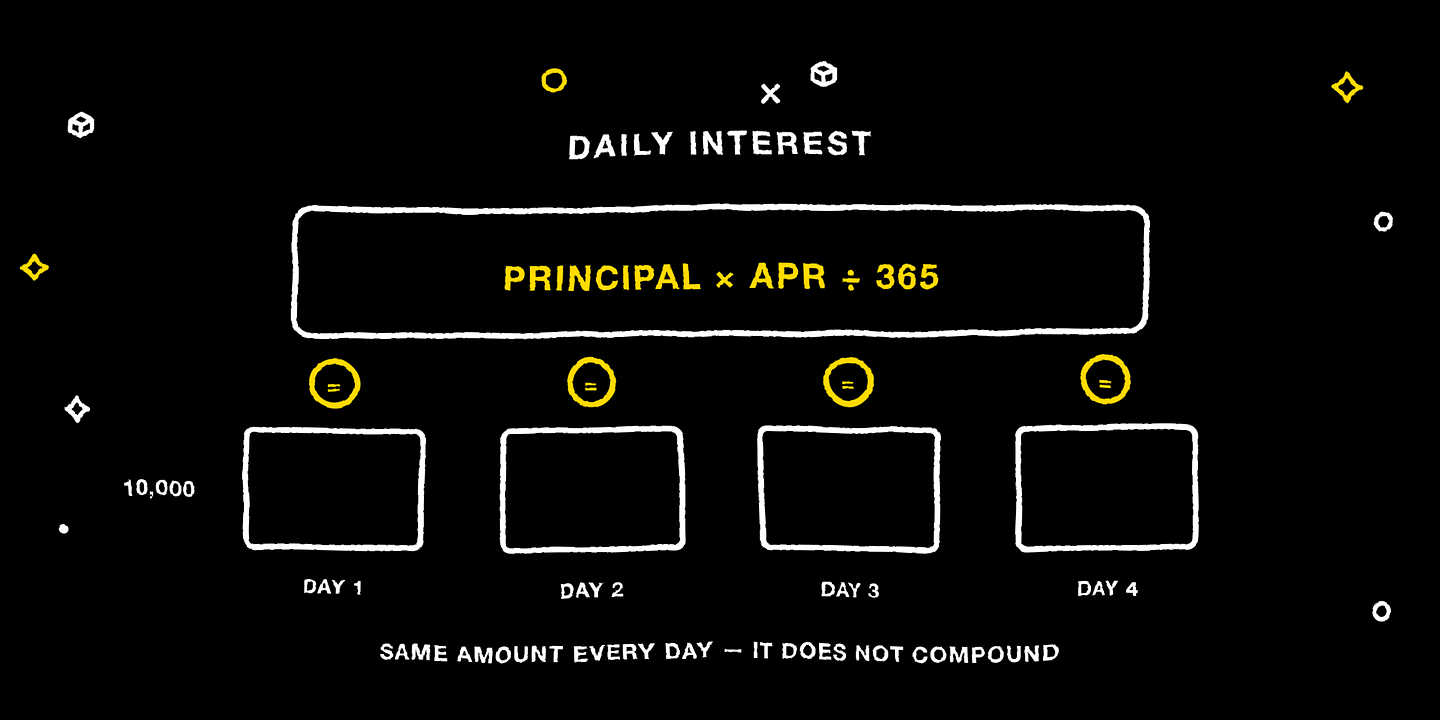
Interest formula (simple interest): Daily Interest = Principal × Annual Rate / 365
Because returns come from real economic activity rather than a fixed promise, APR moves over time. Active periods bring higher yields; quiet periods bring lower yields. Most platforms publish a recent rolling APR (e.g. last 7 or 30 days) — that's a much more useful number than a "headline" rate.
T+1 simple interest
Same T+1 cadence as Earn — earnings on day T are credited on day T+1.
"Simple interest" means earnings are calculated on your deposited principal, not compounded automatically. So a $10,000 deposit at, say, an 8% annualized simple rate earns the same daily amount throughout the period; the $10,000 doesn't grow into $10,022 then earn interest on $10,022 the next day, unless you actively re-deposit your earnings.
If you want compounding, you can do it manually: when interest is credited, deposit those earnings back into the vault.
The 4-day lock-up
When you deposit into MLP, your USDC is locked for 4 days before it can be withdrawn. This is the most important mechanical feature to understand before depositing.
Why the lock exists: the vault provides liquidity that supports trading. If depositors could pull capital instantly during stress, MLP wouldn't be reliable liquidity at all — it would amplify, not absorb, market shocks. The 4-day lock guarantees a minimum stability window for the capital, which is also what enables the fee-sharing model to be economically viable. Without a lock, there's no premium yield to share.
What the lock means in practice:
Day 0: you deposit. Funds are in. Earnings begin accruing (T+1 settlement).
Days 1–4: you cannot withdraw. You can still see your balance and accrued earnings.
Day 4 onward: you can initiate a withdrawal at any time.
Critically: only deposit money you can confidently leave alone for at least 4 days.
The real risks of MLP
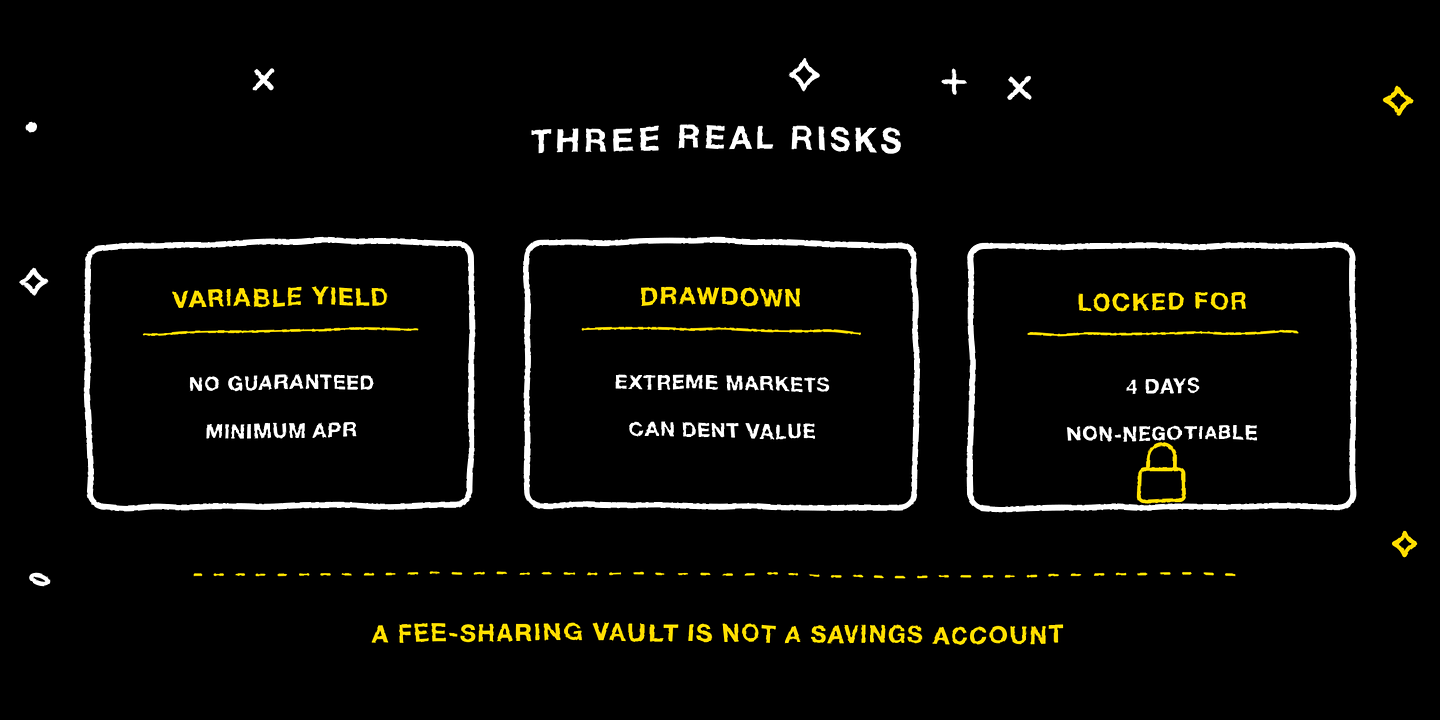
A fee-sharing vault is not a savings account. Three categories of risk to understand:
Variable yield. Earnings depend on platform activity. There is no minimum guaranteed APR.
Drawdown risk during extreme events. MLP backstops trading activity. In rare, extreme market conditions, the vault can experience temporary drawdowns if liquidations or insurance fund mechanisms produce a net loss before fee revenue catches up. Over longer time frames the fee stream is designed to more than compensate, but you can have periods where MLP value moves down before recovering.
Liquidity / lock-up risk. The 4-day window is non-negotiable. If you need the capital sooner — for a margin top-up, an opportunity, an emergency — that capital is not available.
A useful frame: MLP returns reflect the platform's economics over time. In healthy ecosystems, that's a real, attractive yield. In stressed conditions, you're sharing real platform exposure. Both are part of the deal.
Depositing into the Vault
Make sure you have USDC in your trading account. Vault deposits are USDC-only.
Open the Vault page under the Earn section.
Read the current APR and recent yield history. This tells you what depositors have been receiving — the most honest forward-looking estimate available.
Enter the deposit amount. Confirm you're comfortable leaving this amount untouched for at least 4 days.
Review and confirm. After confirmation, the deposit is final.
Monitor — but don't micromanage. Daily earnings accrue and settle T+1. You don't need to do anything for the deposit to keep earning.
When you're ready to withdraw (after the 4-day window), open the same page and initiate withdrawal. Funds return to your USDC trading balance.
3. The Five Differences That Actually Matter
Reading them in order builds the comparison from the ground up.
Lock-up. Earn: none — withdraw any time. Vault: 4 days.
Risk profile. Earn: low. Yield from lending; counterparty and platform risk exist but are limited. Vault: moderate. Returns plus exposure to extreme market events.
Yield level. Earn: lower (the price of full liquidity). Vault: higher (the price of the lock and the activity-linked exposure).
Supported assets. Earn: 5 supported assets, coin-denominated. Vault: USDC only.
What you actually own. Earn: a deposit in a flexible yield product. Vault: a share of MLP — economic participation in the platform's trading economics.
4. The Decision Tree
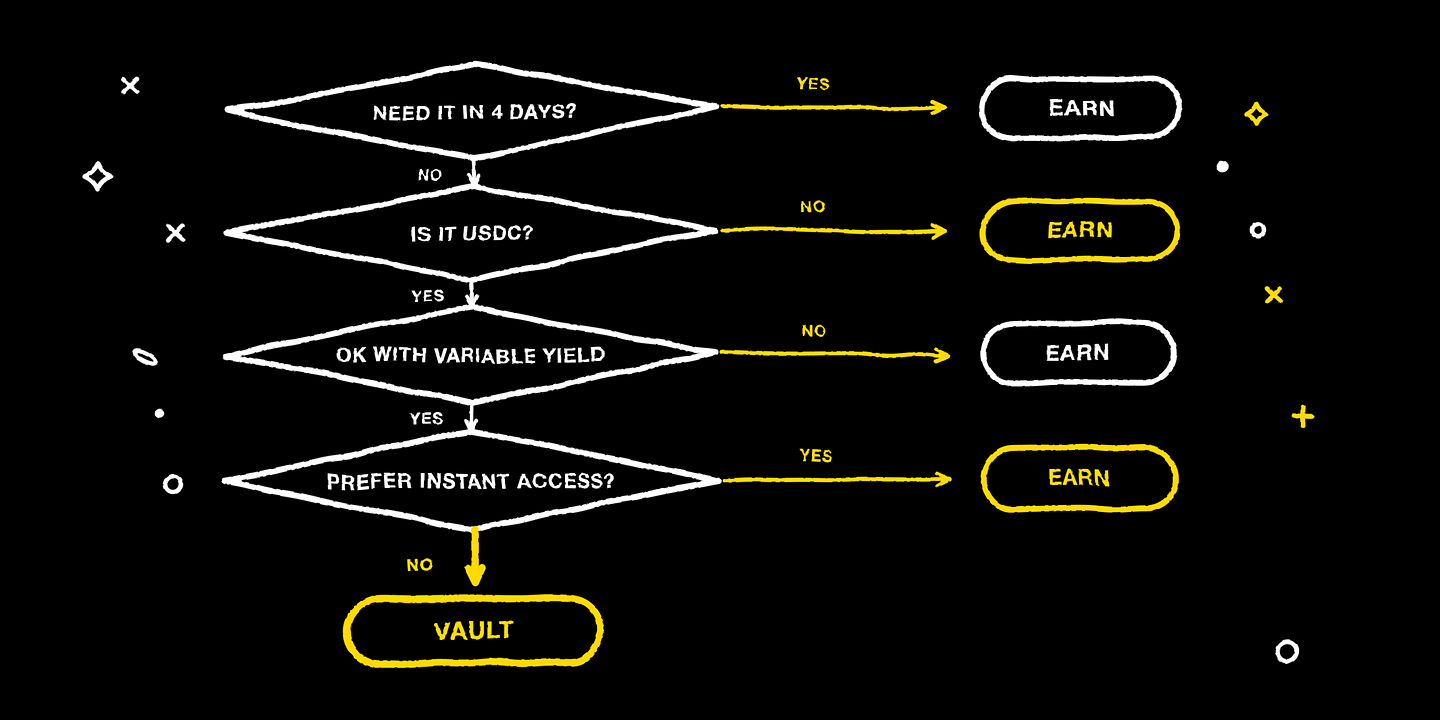
Ask yourself these four questions, in order:
Q1 — Will I need this money in the next 4 days? Yes → Earn. No → continue.
Q2 — Is the asset I want to deposit USDC? No (BTC, ETH, SOL, etc.) → Earn. Yes → continue.
Q3 — Am I comfortable with variable yield and possible short-term drawdown in exchange for a higher rate? No → Earn (it's the more conservative product). Yes → continue.
Q4 — Do I value full optionality (instant withdraw) over the higher Vault yield? Yes → Earn. No → Vault.
That's it. Most users land on Earn for at least some portion of their balance. A subset with USDC they're confident leaving alone for at least 4 days, comfortable with the risk-return profile, choose Vault for the rest.
5. Common Scenarios, Mapped
Five real situations and the natural answer for each:
"I have USDC sitting between trades, and I might need it on short notice." → Earn. Full liquidity is the entire point. Vault would lock you out exactly when you need to act.
"I'm holding BTC for the long term and won't be touching it for months." → Earn. Vault doesn't accept BTC. Earn pays BTC-denominated yield, which compounds your existing long position.
"I have $10,000 USDC I'm definitely not deploying for at least a month." → Vault is a reasonable choice. The 4-day lock is well within your time horizon.
"I want to start earning yield on my crypto but I'm new and a bit cautious." → Earn. It's the more conservative product across every dimension.
"I have a mix — some USDC I'll trade with, some USDC I won't touch, plus some BTC and ETH I'm holding." → A blend. Active USDC and the BTC/ETH go into Earn. The "definitely won't touch" USDC can go into Vault. Most experienced users do exactly this.
6. Using Both at the Same Time
For many users, that's the right answer.
Earn and Vault aren't competing for the same dollar; they're built for different roles. A reasonable allocation might look like:
Working balance (capital you may use as trading collateral or for opportunistic positions): in Earn, in the relevant asset.
Long-term holdings (BTC, ETH, SOL kept for months or years): in Earn, generating coin-denominated yield on top of price exposure.
Locked-aside USDC reserve (capital consciously set aside, comfortable leaving for at least 4 days): in Vault, accepting the higher yield in exchange for the lock.
The discipline is to be honest about which capital actually fits each role. Vault is not for money you "probably won't need for 4 days." It's for capital you've made a conscious decision to commit. Earn is the default home for everything else.
Further Reading
What Is Earn (Flexible Savings)? An Interest-Bearing Account You Can Deposit and Withdraw Anytime
What Is the MLP Vault? Deposit USDC to Share the Platform's Fees
7. Quick Recap
The four ideas worth keeping:
Earn — flexible yield product, 5 supported assets, T+1 accrual, coin-denominated, no lock-up. The flexible default for working balances and long-term holdings.
Vault (MLP) — USDC liquidity partnership, T+1 simple interest, 4-day lock, share of the platform's trading-fee revenue. Higher yield in exchange for commitment and activity-linked exposure.
Decision tree: Need it in 4 days? Not USDC? Risk-averse? Want full liquidity? Any "yes" sends you to Earn. Only USDC you're sure about for at least 4 days, with tolerance for activity-linked exposure, fits Vault.
Most users are best served by using both — Earn for working and long-term holdings; Vault for capital consciously set aside.
Note: Your deposit capacity is linked to your points tier — higher points unlock a higher deposit ratio. Points can be earned through trading and referrals. Check the Vault page for the current tier breakdown.
Risk Disclosure
Both Earn and Vault are yield products with real risks. Earn carries counterparty and platform-related risks tied to lending activity; Vault carries those plus exposure to platform trading activity, including the possibility of temporary drawdowns in extreme market conditions. Yields are variable and historical APRs do not guarantee future returns. Locked deposits cannot be withdrawn during the lock-up window. Mechanics described here reflect current platform parameters and may be updated; always check the official documentation before depositing. Only deposit capital you can afford to lose access to — and afford to lose.