
How Are MC Markets' Fees Calculated? A Full Rate Table for Standard, Advanced, and VIP Discounts
The market decides whether you win or lose; fees decide how much you get to keep — the good news is, for most people, fees are 0.


Introduction
This article makes clear every cost you'll pay on MC Markets: the difference between the two account types, the full rate table, VIP discounts, and the funding rate that beginners most easily overlook.
1. First, Pick the Right Fee Mode: Two Account Types
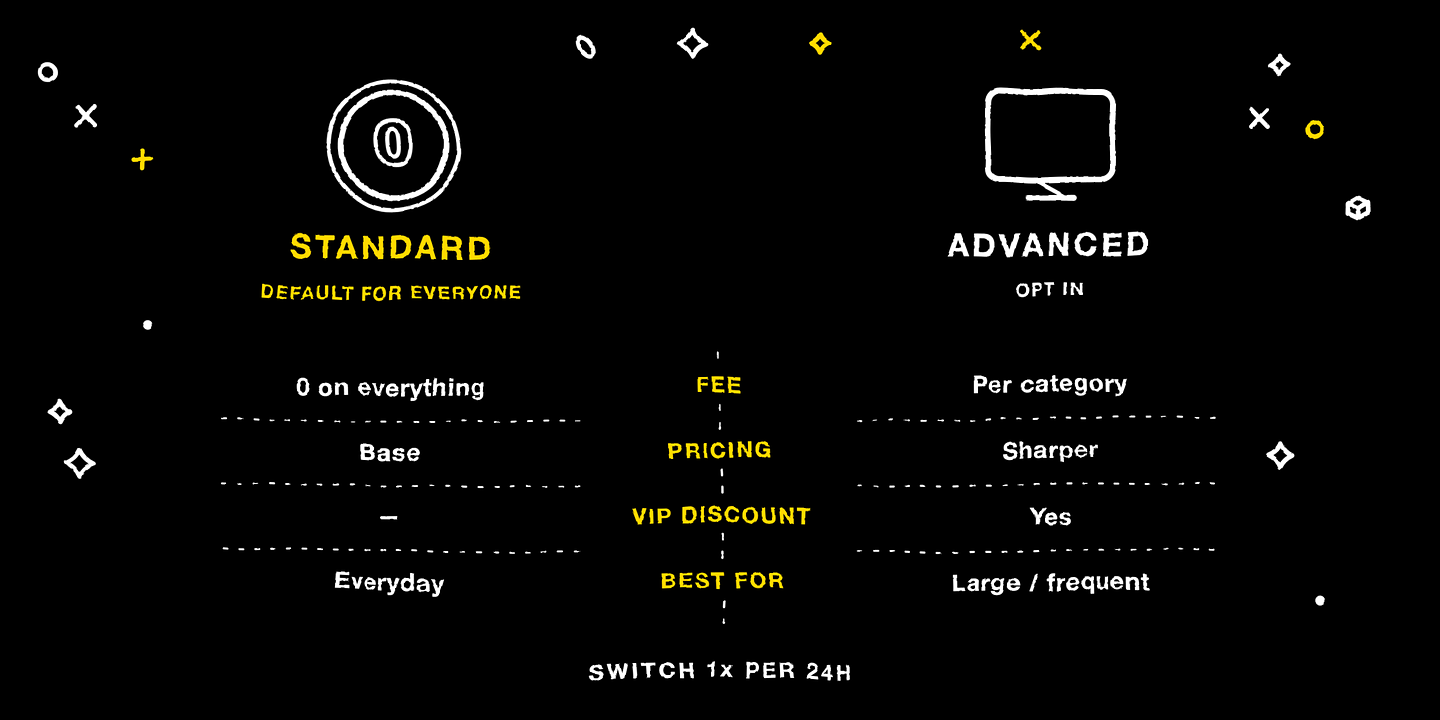
All users default to the Standard Account — fee-free across all instruments, in exchange for less competitive pricing, suited to everyday trading. The Advanced Account charges fees per instrument but offers better execution and more competitive pricing, suited to large-volume, high-frequency traders or those with strict requirements on execution price.
How to switch: tap to switch on the “Portfolio” page, limited to once every 24 hours, affecting only new orders placed afterward.
2. Advanced Account Rate Table (VIP0 One-Way Fees)
Below are the one-way fees for the Advanced Account's default tier, charged once on opening and once on closing, calculated on the trade's notional value. All instruments are 0 for the Standard Account.
| Category | Example | One-way fee |
|---|---|---|
| Crypto spot | BTC/USDC, etc. | 0.05% |
| Crypto perpetuals | BTC / ETH / SOL, etc. | 0.01% |
| Gold | XAUUSD | 0.005% |
| Major forex | EURUSD / GBPUSD / USDJPY / USDCHF | 0.004% |
| Minor forex | USDCAD / AUDUSD / NZDUSD | 0.006% |
| Silver | XAGUSD | 0.01% |
| Crude oil | USOIL | 0.01% |
| Indices | NAS100 / US30 / US500 | 0.01% |
| US-stock reference prices (perpetuals) | AAPL / TSLA, etc. | 0.015% |
A worked example: an Advanced Account VIP0 user opens a $10,000 gold contract; the fee = 10,000 × 0.005% = $0.5 (one way), $1 round trip. For the same trade, a Standard Account user pays 0.
3. VIP Tiers and Discounts (Advanced Account Only)
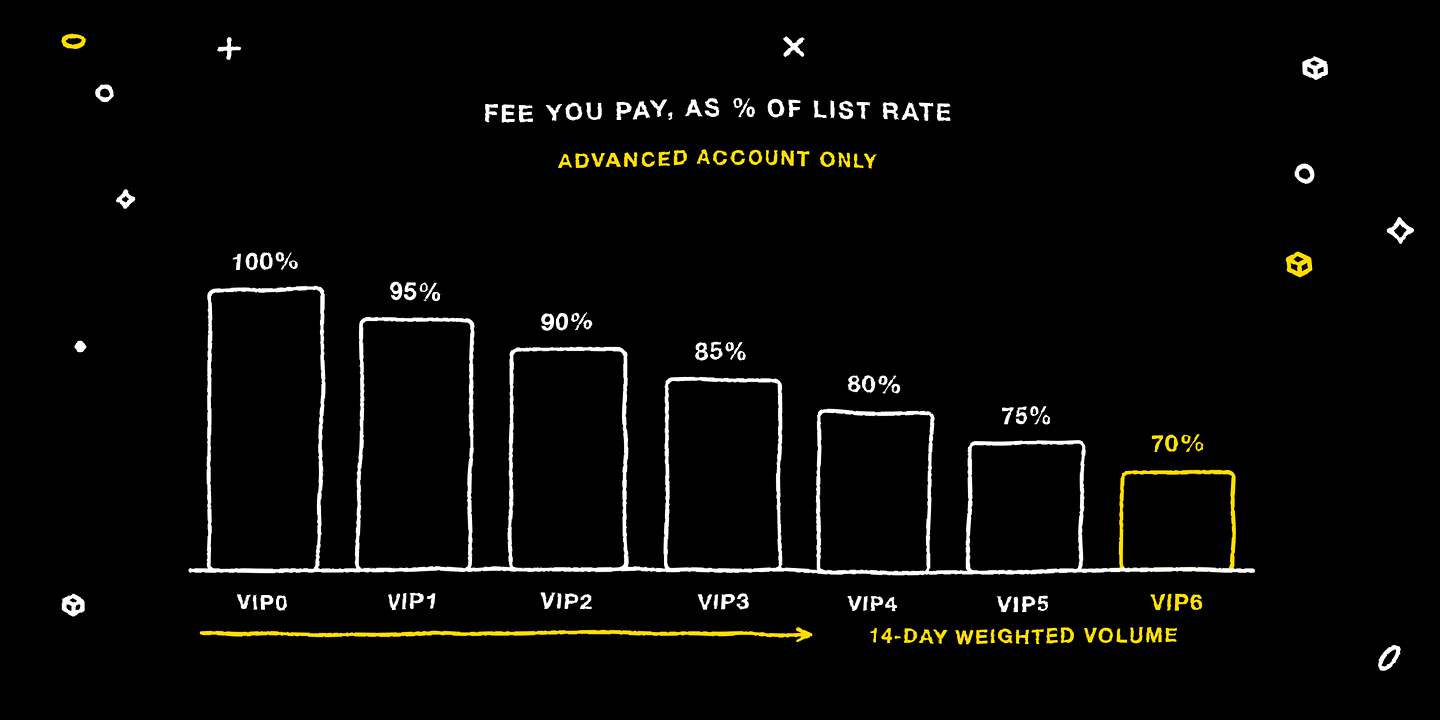
VIP tiers are upgraded based on weighted trading volume over the past 14 days, with volume across all categories added at an equal 1:1 weight, and the discount applies to all categories in the Advanced Account.
| Tier | 14-day weighted volume (USD) | Discount |
|---|---|---|
| VIP0 | Default | No discount |
| VIP1 | ≥ 5,000,000 | 5% off |
| VIP2 | ≥ 25,000,000 | 10% off |
| VIP3 | ≥ 100,000,000 | 15% off |
| VIP4 | ≥ 500,000,000 | 20% off |
| VIP5 | ≥ 2,000,000,000 | 25% off |
| VIP6 | ≥ 7,000,000,000 | 30% off |
Two important rules: the Standard Account is fee-free and does not involve VIP discounts; trading volume for the Standard and Advanced Accounts accumulates continuously across accounts, so switching account type does not reset your VIP progress.
4. Funding Rate: The “Holding Rent” Unique to Perpetuals
Traditional futures have an expiry date and settle at the spot price on expiry, so the price naturally converges. Perpetuals have no expiry, so a funding rate is needed to replace that corrective force.
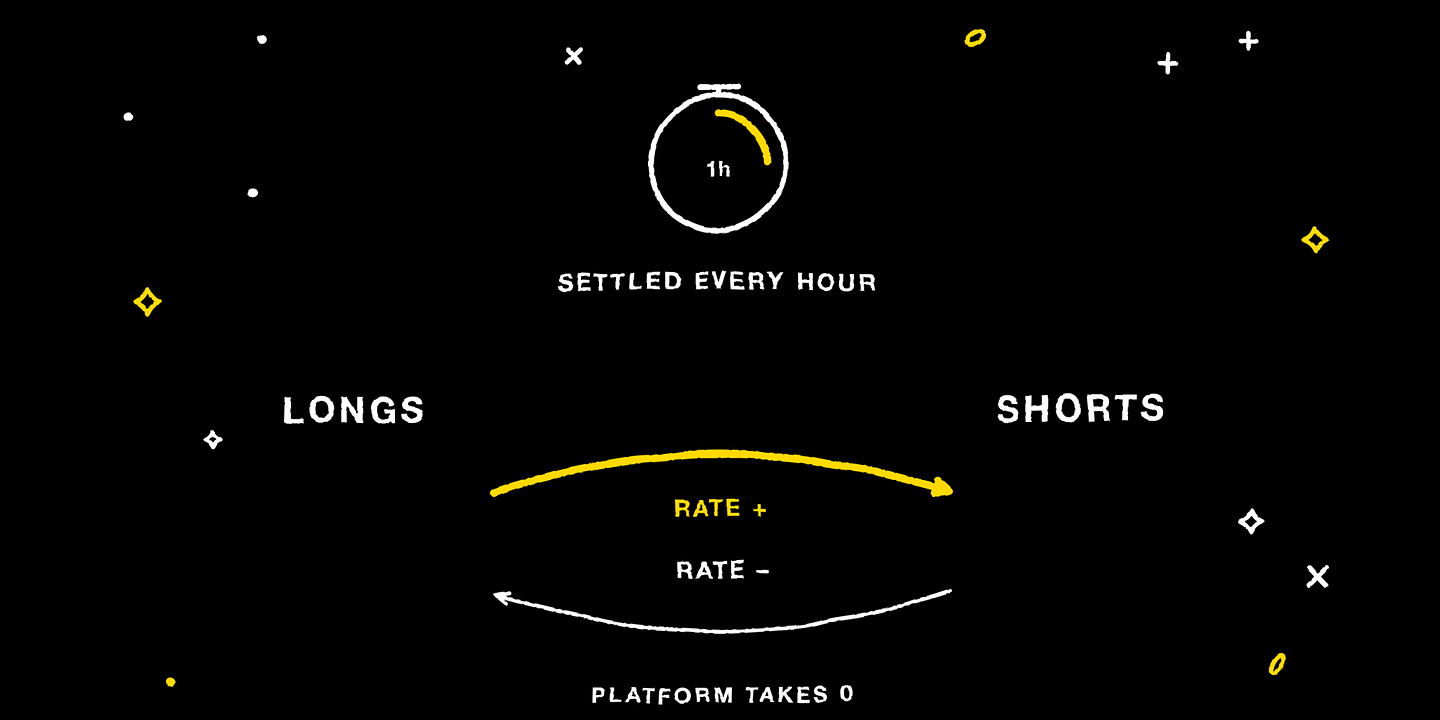
How it works: it settles once on the hour, every hour, and whichever side pushed the contract price off balance pays. A positive rate means longs are too crowded and the contract price is above spot, so longs pay shorts; a negative rate is the reverse. The platform doesn't take this money — it only flows between traders.
Note: this is not a trading fee. Fees are charged once each on opening and closing; the funding rate is a “rent” continuously deducted as long as you hold a position. A single instance is tiny (e.g., 0.01%), but once an hour it adds up — holding a 10,000 USDT long for three days could accumulate to 0.7% to 2% of notional value. Take a look at the current rate before holding overnight.
5. Other Fees
Instant Swap: a free allowance of 2,000 USDC per day, reset at UTC 00:00; anything above is charged at the normal rate. Transfers between accounts: free and instant. Deposits: the platform charges nothing, you only pay on-chain gas. Withdrawals: as shown on the withdrawal page — consolidating withdrawals is usually more cost-effective than multiple small ones.
FAQ
Q: Does the platform take the funding rate?
A: No. It flows directly between long and short traders; the platform takes none of it. But it does affect your holding cost.
Q: Does switching account type reset my VIP?
A: No. Trading volume accumulates continuously across account types.
Quick Recap
The Standard Account has 0 fees on all instruments; the Advanced Account charges per category, with VIP discounts down to 30% off. The funding rate settles hourly and flows between longs and shorts. Three things to lower your costs: pick the right account type, use limit orders more, and control your trading frequency.
Risk Warning
Fees are subject to the latest disclosure on the official fee page.
Disclaimer
This article is for general informational and educational purposes only and may not apply to the regulations or products available in your region. It does not constitute investment, financial, or trading advice of any kind, nor an offer, solicitation, or recommendation to buy, sell, or hold any digital asset.
Trading digital assets involves high risk, prices can be extremely volatile, and you may lose all of your invested capital. Leveraged trading can result in losses exceeding your initial deposit. Past performance is not indicative of, and does not guarantee, future results.
You should make investment decisions independently based on your own financial situation and risk tolerance, and consult a licensed professional adviser where necessary. While we strive to ensure the accuracy of the information in this article, MC Markets accepts no liability for any errors or omissions, or for any loss you may suffer from using or relying on this information.
No more