Instant Swap: 1-Click Exchange Across 5 Assets
Instant conversion with rates that refresh every 10 seconds — what swap is, when to use it, and how it differs from spot trading.

Exchange rates are updated every 10 seconds (subject to real-time display on the page and final system settlement). A daily fee-free quota of 2,000 USDC applies; amounts exceeding the quota are charged at the standard rate. The quota resets at UTC 00:00 each day. Rates reference live market prices, and pairs with higher liquidity typically offer tighter spreads.
Introduction
Sometimes you don't want to read an order book. You don't want to think about bid versus ask, market versus limit, maker versus taker. You just want to turn one asset into another, right now, at a price you can see clearly before you click. That's exactly what Instant Swap is built for.
This guide explains how the platform's 1-click swap works across 5 supported assets (including BTC, ETH, SOL, and USDC), why the rate refreshes every 10 seconds, where the cost actually lives, and — just as important — when you should not use swap and use spot trading instead.
1. What Instant Swap Actually Is
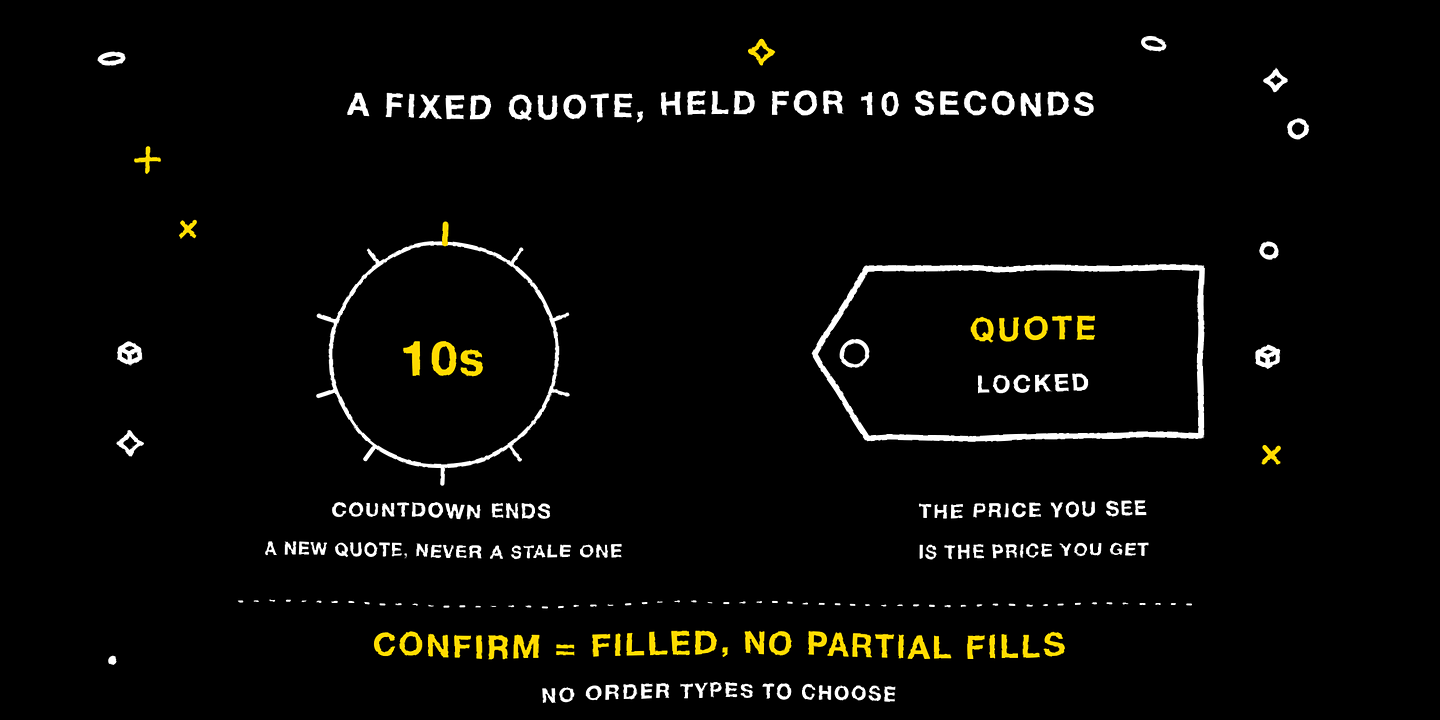
Instant Swap is a quote-based conversion service. Instead of placing an order on a public order book and waiting for someone to take the other side, you ask the platform: "How much ETH will I get for 1,000 USDC right now?" The platform shows you a fixed quote. If you click confirm, that's exactly what you get.
Three properties define the experience:
- One-click execution. No order types, no slippage tolerance setting, no waiting. Click and the conversion is done.
- Quoted rate, not order book price. What you see is what you get. There's no walking the book, no partial fills, no surprises in the average fill price.
- Fixed quantity in, fixed quantity out. When the rate is shown, the entire trade is committed at that single rate.
This is the same pattern you've probably used at an airport currency kiosk: you walk up, the screen shows "1 USD = 0.92 EUR," you hand over your dollars, you walk away with the exact corresponding euros. Simple. Final. No homework required.
2. Why Rates Refresh Every 10 Seconds
Crypto prices move continuously. A quote shown to you at 12:00:00 will not necessarily be valid at 12:00:30 — the underlying market may have moved, and the platform that's giving you the quote needs to manage its own risk.
The 10-second refresh is the compromise that makes one-click swap workable:
- For you, it means the rate you see is stable long enough to actually read it and decide. You're not watching a number flicker every millisecond like an order book.
- For the platform, it means quotes are recent enough that they reflect current market conditions, so the platform isn't taking on stale-quote risk.
Practically, this means: see the rate → decide → click within the 10-second window. If the window expires, a new rate appears, and you decide again on that one. You're never forced to act on a price that's already obsolete.
3. The 5 Supported Assets
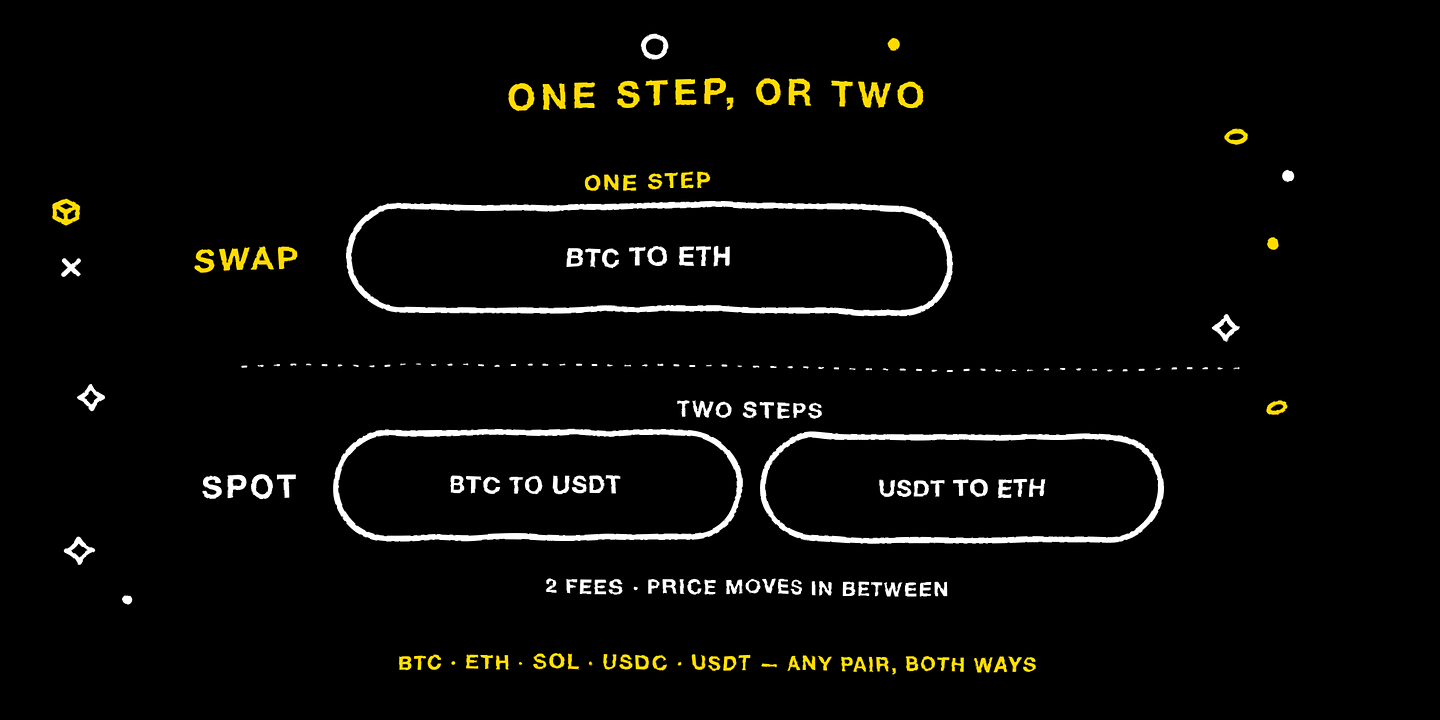
Instant Swap supports conversion across 5 major assets — BTC, ETH, SOL, USDC, and USDT — and you can swap freely between any pair of them, in either direction. Common patterns include:
- USDC → BTC / ETH / SOL: the simplest way to move from cash into a crypto position.
- BTC / ETH / SOL → USDC: taking profit (or cutting a position) back into stable form.
- BTC ↔ ETH, ETH ↔ SOL, etc.: rebalancing between major holdings without first converting to stablecoin and back.
That last point matters. On a traditional spot order book, swapping BTC into ETH usually means two trades (BTC → USDC, then USDC → ETH), paying two sets of fees and being exposed to price movement between the trades. Instant Swap collapses this into a single, atomic conversion.
4. Where Does the Cost Live?
This is the most important thing to understand about swap, because it's the easiest thing to miss.
Spot trading shows you a fee line item — for example, 0.05% per trade — and the order book price is set by competing buyers and sellers. The fee is explicit.
Instant Swap doesn't typically show a fee line. Instead, the cost is built into the quoted rate as a small spread relative to the underlying market mid price. The spread is the platform's compensation for offering you instant, no-risk-to-you execution.
Daily fee-free quota: Instant Swap offers a daily fee-free quota of 2,000 USDC. For amounts exceeding the daily quota, fees apply as shown on the Swap page.
For most retail-sized swaps, this spread is competitive and the convenience is worth it. For larger conversions, the cost comparison changes — at a certain size, the spot order book (with a tight bid/ask spread plus the explicit 0.05% fee) becomes meaningfully cheaper than the swap quote, even though it requires more clicks and a little more attention.
A useful rule of thumb:
- Small conversions (a few hundred to a few thousand dollars equivalent): swap is almost always the better choice. Simpler, faster, and the cost difference vs spot is small in absolute terms.
- Larger conversions: check both — pull up the swap quote and compare against the spot order book. If you'd save meaningfully on the order book, the extra effort is worth it.
5. Swap vs Spot, Side by Side
Both turn one asset into another, but they're different products with different strengths:
- Speed. Swap is one click. Spot requires choosing an order type, entering price (for limits), and managing slippage tolerance.
- Price predictability. Swap shows you the exact rate before you confirm. Spot market orders have variable slippage; spot limit orders have predictable price but uncertain fill.
- Cost transparency. Spot has an explicit 0.05% fee plus the natural bid/ask spread. Swap bundles its cost into the quoted spread — equally real, just less visible.
- Best at scale. Spot handles large orders better because deep order book liquidity prices size more efficiently. Swap is optimized for one-and-done retail flow.
- Best for cross-asset (e.g. BTC ↔ ETH). Swap wins clearly because spot would require two separate trades.
The mental model: swap is for "I just want this conversion done." Spot is for "I want to control the execution and squeeze out the best price."
6. Making a Swap, Step by Step
A complete conversion, from start to finish:
- Open the Swap page. A two-panel interface: "From" asset on top, "To" asset on bottom.
- Pick your direction. For example, "From USDC" → "To ETH". You can swap any of the 5 supported assets into any other.
- Enter the amount. Either how much you want to send, or how much you want to receive — the other side calculates automatically.
- Read the rate carefully. The displayed rate is what you'll get. A countdown timer (typically 10 seconds) shows how long this quote is valid.
- Confirm before the timer expires. Click confirm, and the conversion executes immediately.
- Check your balances. The "From" asset has decreased; the "To" asset has increased by the quoted amount.
If the timer runs out before you click, the panel will refresh with a new quote based on the current market. That's not an error — it's the protection mechanism doing its job.
7. Common Mistakes to Avoid
Five patterns that catch new users:
- Ignoring the rate when it refreshes. A quote that ticked from "you'll receive 0.305 ETH" to "you'll receive 0.298 ETH" between glances tells you the underlying market moved meaningfully. Don't autopilot through the click — re-read the rate after each refresh.
- Using swap for very large conversions without comparing. On size, the spot order book is often cheaper. Always pull up both before clicking on a five- or six-figure conversion.
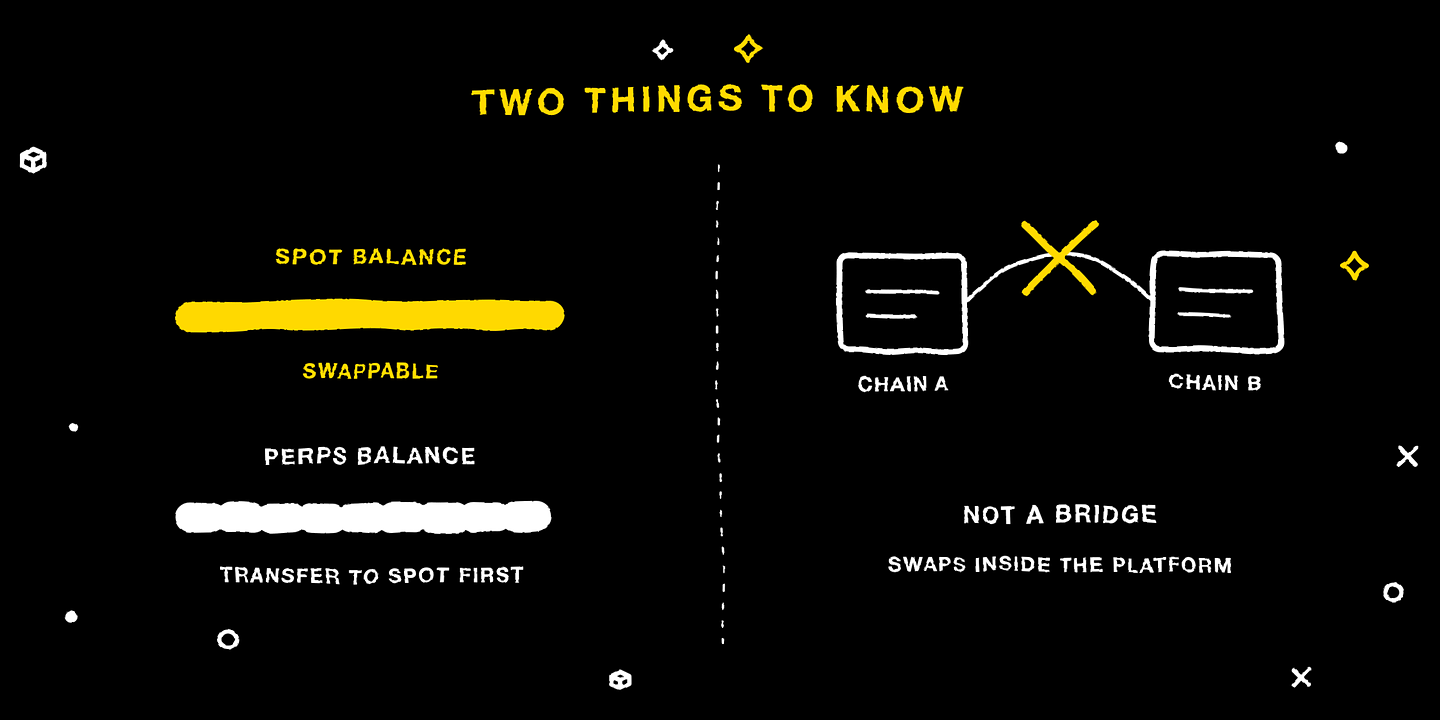
- Confusing swap with cross-chain bridge. Instant Swap converts one asset into another on the platform. It does not move assets between blockchains (e.g. ETH on Ethereum to ETH on Solana). For that, you need a bridge, which is a different operation entirely.
- Trying to "trade" with swap. Swap is built for occasional conversions. If you're actively trading — entering and exiting positions multiple times a day — spot or perpetuals will give you better economics and far more control.
- Not understanding stablecoin pairs. "USDC → USDT" still has a small spread, even though both are dollar-pegged. The 1:1 peg is approximate, not exact, and a swap will reflect the small market difference.
What is the difference between Swap and Spot Trading? Swap allows you to instantly convert one asset to another using the platform's internal pricing engine, without placing orders on an order book. Spot Trading requires placing buy or sell orders on the market and matching with other traders. Execution depends on available liquidity and market prices.
8. Quick Recap
Conditions for using Swap: The assets you want to swap must be available in your Spot Account and not held by any pending orders or ongoing withdrawals.
The four ideas worth taking with you:
- Instant Swap is a quote-based, one-click conversion service. What you see is what you get — no order book, no slippage to manage.
- Rates refresh every 10 seconds. That window is long enough to read and decide, short enough that the platform isn't quoting stale prices.
- The cost is in the spread, not in a fee line. For small conversions, swap is competitive and convenient. For large or active trading, spot will usually be cheaper.
- 5 supported assets, any-to-any. BTC, ETH, SOL, USDC, and USDT can be swapped between each other freely — including direct cross-asset swaps that would require two trades on spot.
Risk Disclosure
Please note that only funds in the Spot Account can be used for Swap. Funds in the Perps Account must be transferred to the Spot Account to be used for swapping.
Crypto markets are volatile and asset prices can change significantly even within the 10-second quote window. The supported assets, available pairs, and exact swap mechanics described here reflect current platform settings and may be updated; always check the official documentation before transacting. Past performance does not guarantee future results. Trade only with capital you can afford to lose.
No more